NES · Game Boy1990PuzzleNintendo R&D1Fever & ChillUp to 84 viruses a bottleSame-day launch on two systemsArcade versions tooOn Nintendo Switch Online
Dr. Mario
Mario swaps his overalls for a white coat. In Dr. Mario the falling pieces are two-tone vitamin capsules and the well is a medicine bottle crawling with red, blue and yellow viruses. Line up four of one colour, virus included, and they vanish; wipe out every germ and the bottle is cured. Choose a virus level from 0 to 20 (up to 84 viruses), a speed of Low, Med or Hi, and one of two of Nintendo’s catchiest tunes, Fever or Chill. Nintendo R&D1 launched it on the Famicom and Game Boy on the same day, 27 July 1990, with arcade versions in the US that summer; the programmer was Takahiro Harada, the producer Gunpei Yokoi and the composer Hirokazu Tanaka. Hidden behind the higher levels are little reward films, the best of them involving a UFO. It has since been reissued on almost every Nintendo system and started a series that runs to Dr. Mario World.
Developer:Nintendo R&D1
Publisher:Nintendo
Platforms:Famicom / NES; Game Boy; arcade (VS. System, PlayChoice-10)
Genre:Falling-piece puzzle
Japan:27 July 1990 (Famicom and Game Boy, as Dokutā Mario)
N. America:October 1990 (NES); Game Boy October 1990 according to Wikipedia, 1 December 1990 according to other sources; arcade August 1990
Europe:Game Boy 30 April 1991; NES 27 June 1991
Australia:NES 27 June 1991
Players:1–2 (Game Boy two-player needs a Game Link cable)
Producer:Gunpei Yokoi
Programmer:Takahiro Harada
Music:Hirokazu Tanaka (Fever and Chill)
Levels:Virus levels 0–20 to choose from (4 to 84 viruses); play continues beyond 20
Speeds:Low, Med, Hi (VS. Dr. Mario: Norm and Hi)
Sales:About 3.6 million in Japan (Famicom and Game Boy, Famitsu data); 10.19 million worldwide in one published estimate (see Reception)
Ratings:ESRB E · PEGI 3 · CERO A (re-releases)
Re-releases:Game Boy Advance (2004), Virtual Console (3DS 2011–12, Wii U 2014), NES Classic (2016), Nintendo Switch Online (NES 2018, Game Boy 2024)
Advertisement
Overview
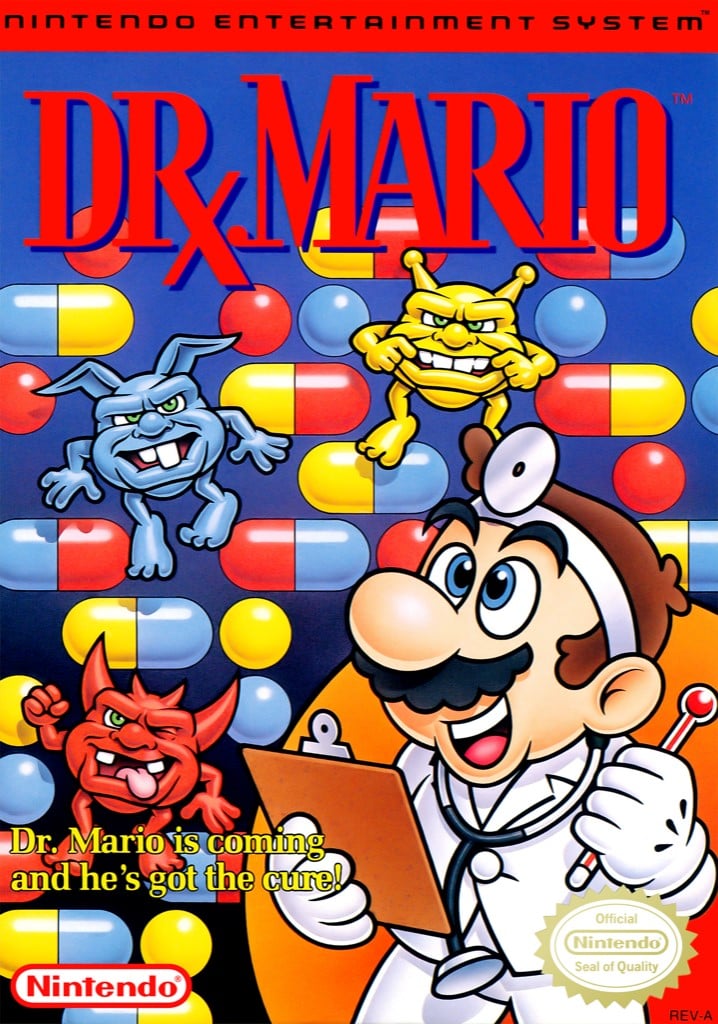
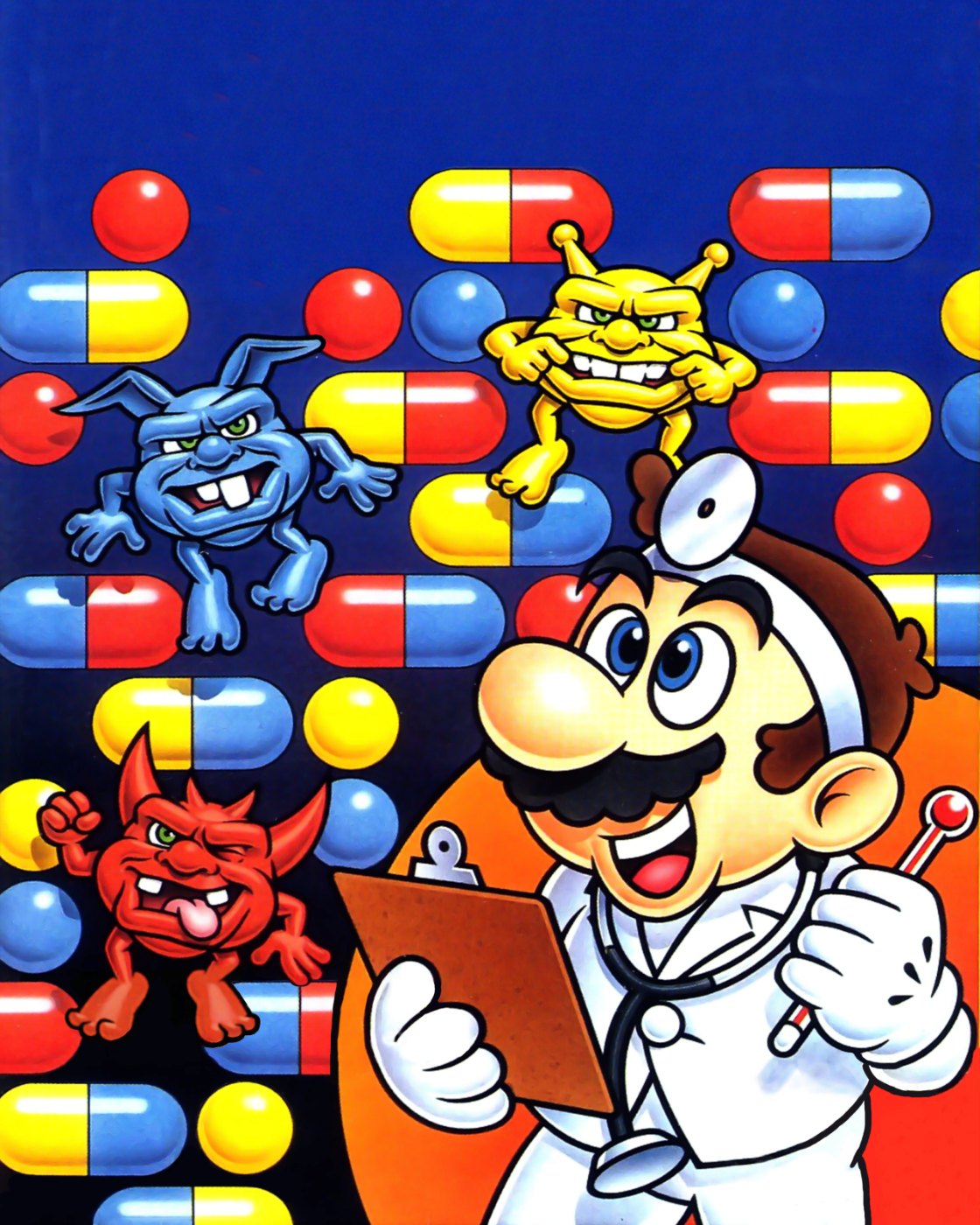
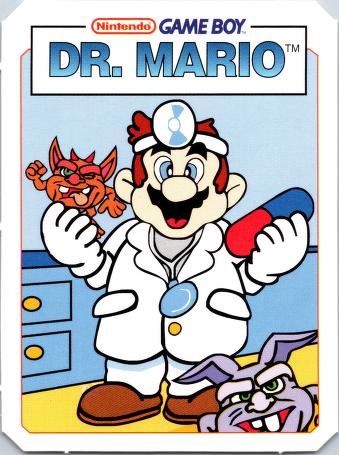
Dr. Mario juggling vitamin capsules in Nintendo’s artwork.
In 1990 Nintendo’s biggest puzzle hit, Tetris, was a game it published but did not own. Its reply was a falling-piece puzzler of its own, with its mascot in charge. Dr. Mario drops two-part capsules into a bottle instead of blocks into a well, and instead of clearing lines you are hunting germs. Every level starts with a scatter of viruses already lodged in the bottle; your job is to land capsule halves of the right colour on top of or beside them until four of a kind sit in a row or column. When the last virus pops, the bottle is clean and the next, busier one arrives.
That one change gives the game its own rhythm. The viruses never move, so instead of reacting to whatever falls you are planning a few capsules ahead, working out how to reach a buried blue germ without smothering the red one next to it. Clearing a line lets the loose halves above it tumble, and with care they will land in another match, so setting up chains is a big part of the skill.
Nintendo R&D1 built it for the Famicom and the Game Boy together, and both went on sale in Japan on the same day in July 1990. The NES version plays to a big, bold bottle with Mario lobbing each capsule in from the side; the Game Boy one is the same game in monochrome, with its reward films moved under the sea. A two-player race, in which each player picks their own level and speed and every combo sends rubbish into the other bottle, was the feature reviewers liked best, and two coin-op versions went into American arcades that summer.
Then there is the music. The options screen offers Fever, Chill or silence, and Hirokazu Tanaka’s two themes have followed the doctor all the way into Super Smash Bros. This page covers the 1990 original on both systems; the later games in the series each have a short entry in the legacy section, with links to their own pages.
At Mushroom Kingdom Hospital, nasty viruses are on the loose. It’s time to give them a dose of Mario’s medicine!
In this classic puzzle game, you must eradicate all the viruses in the bottle by spinning and lining up the coloured vitamin capsules as they fall.
The more lines of viruses you clear, the more points you rack up, scoring huge combos. But beware of side-effects: this game may be addictive!
— Official description (Nintendo UK, 2014)
Why Dr. Mario matters to Mario fans
It gave Mario his most famous second job. Dr. Mario, his capsules and his tri-colour viruses began here, and the doctor has since been a fighter in Super Smash Bros., a racer in Mario Kart Tour and the star of a string of puzzle sequels, one of them handed to Luigi as Dr. Luigi. And Fever and Chill have turned up in Super Smash Bros. ever since Melee.
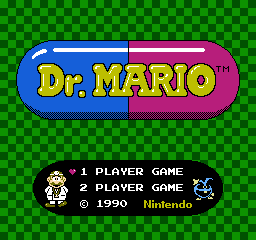
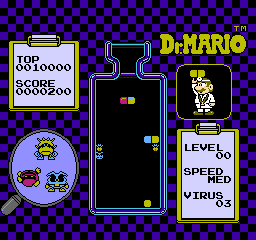
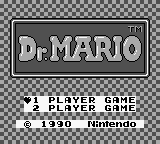
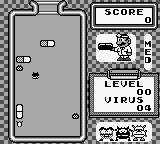
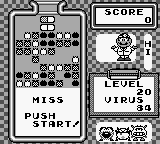
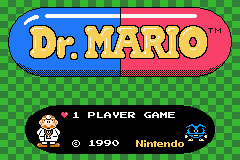
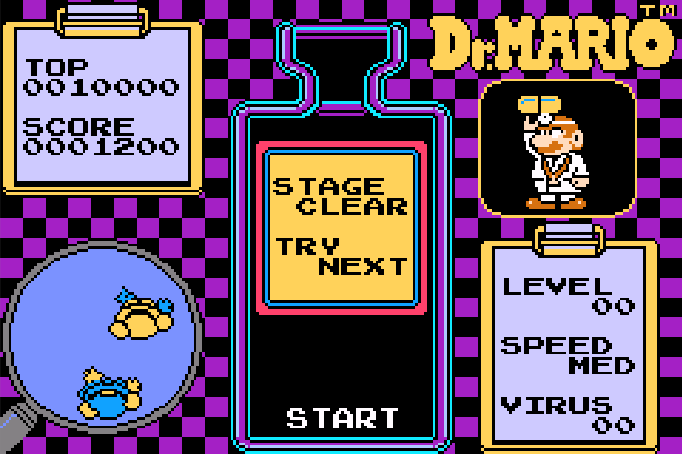
The NES title screen.Level 0 on the NES: four viruses, one capsule in Mario’s hand.The Game Boy title screen.Level 0 on the Game Boy.
Quick Answers
The questions people ask most about the original Dr. Mario, answered briefly here and in depth below.
When did Dr. Mario come out?
On 27 July 1990 in Japan, on the Famicom and the Game Boy at once. North America had the NES version in October 1990 and the Game Boy one in October or December 1990 (sources differ); Europe got the Game Boy version on 30 April 1991 and the NES version on 27 June 1991. More →
How do you clear a virus?
Line up four or more segments of one colour in a row or a column, with the virus as one of the four. Capsule halves can be cleared on their own too, but only viruses score points. More →
How many viruses are there?
Four times the level number plus four: 4 on level 0, 84 on level 20. Levels above 20 keep the count at 84. More →
What are the songs called?
Fever and Chill, both composed by Hirokazu Tanaka. You can also choose to play in silence. More →
How do you see the UFO?
Clear level 20 on Hi speed. On the NES a UFO beams the viruses up; on the Game Boy it tries to, but a coelacanth gets to them first. More →
Who made Dr. Mario?
Nintendo R&D1. Takahiro Harada programmed it, Gunpei Yokoi produced it and Hirokazu Tanaka wrote the music. More →
How many copies did it sell?
Nintendo has not published a total. Famitsu data put Japanese sales at about 2.08 million on Game Boy and 1.53 million on Famicom, and one reference book gives 5.34 million (Game Boy) and 4.85 million (NES) worldwide. More →
Where can I play it today?
Both versions are on Nintendo Switch Online: the NES game since September 2018 (with online two-player) and the Game Boy game since March 2024. More →
Is Nurse Peach in the game?
Only in the back-story and Nintendo’s artwork, where she appears as Nurse Toadstool. Dr. Mario is the only character you see while playing. More →
Modes & Levels
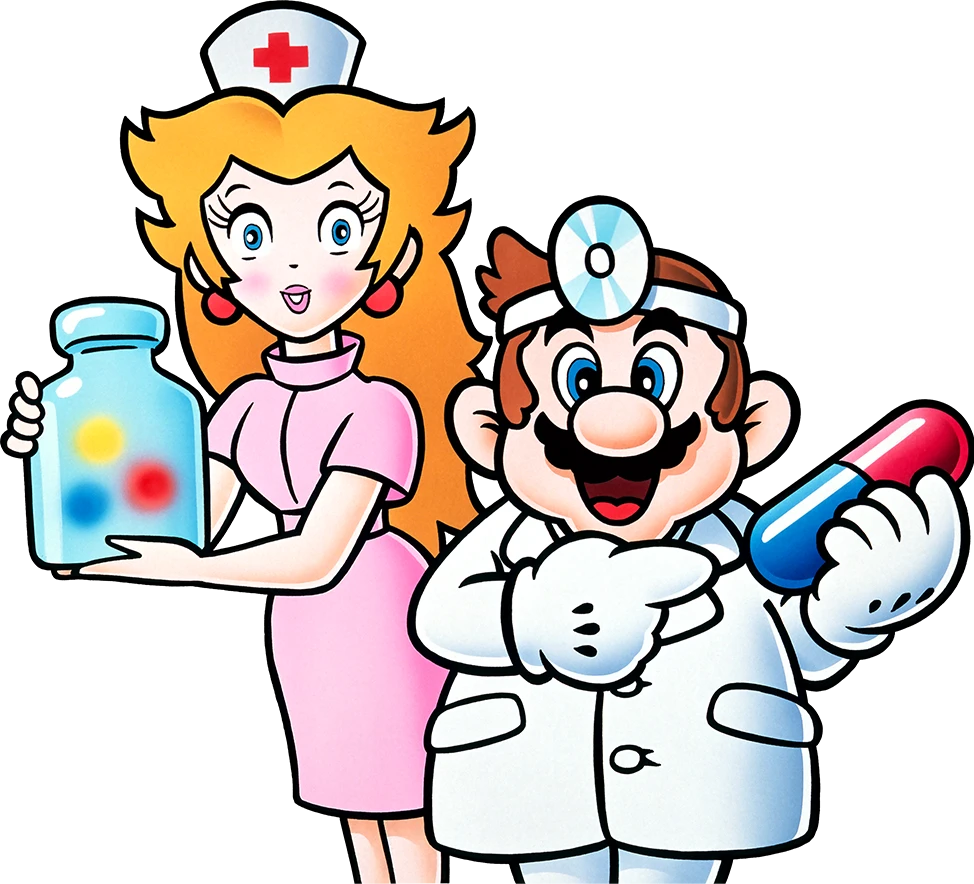
Dr. Mario and Nurse Toadstool.
The set-up is a single paragraph. Dr. Mario and Nurse Toadstool work in the Mushroom Kingdom Hospital’s virus research lab, until an experiment goes wrong and the place fills with viruses in three colours. Luckily the doctor has just come up with a new vitamin, and he sets about prescribing it, capsule by capsule.
There is no ending as such; the game is played for score and for the short films that reward finishing certain levels at certain speeds. Here are the modes on both cartridges and every one of those films.
1 Player Game
Pick a virus level, a speed and a song, and the bottle fills with germs. Clear them all and you move to the next level with your score intact. Mario stands beside the bottle and throws each capsule in. The level counter keeps climbing past 20, though the NES game never puts more than 84 viruses in a bottle.
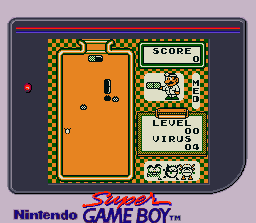
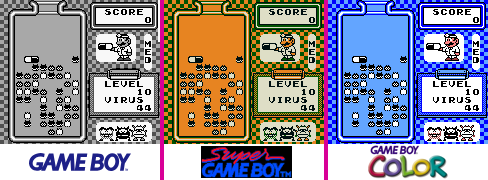
The NES 1 Player Game at level 0.The same on the Game Boy.The Game Boy version on a Super Game Boy, with its own palette.
The NES reward films
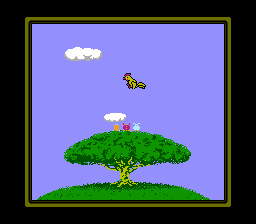
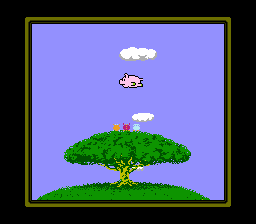
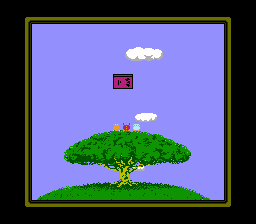
Clear level 5, 10, 15 or 20 on Med or Hi and the NES treats you to a short film in the sky above a tree, with the three big viruses watching. Each is a little piece of nonsense: a book flapping its covers like wings, a rooster, a spray can jetting backwards, a dinosaur paddling along in an eggshell, a flying tortoise, a pig spinning its tail like a propeller and a witch on a broomstick.
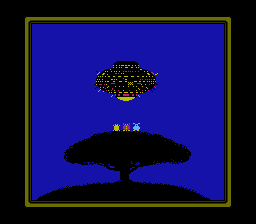
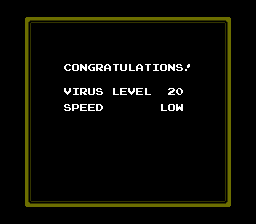
The top prize, for level 20 on Hi, is the famous one. The sky goes dark, the music stops, and a UFO beams the three viruses aboard and flies off, before the sky flashes and stars rain down. Level 20 on Low gets only a brief “Congratulations!” on black, with a slower, higher version of the ending tune.
Level 10 on Med: the rooster.Level 10 on Hi: the propeller pig.Level 20 on Hi: the UFO arrives.
The Game Boy reward films
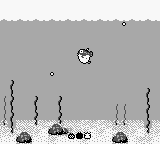
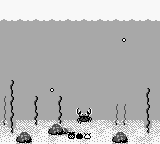
The Game Boy moves the show to the sea bed, where the viruses sit while sea creatures drift past: a nautilus for level 20 on Med, then a pufferfish, a crab and a flying fish for levels 5, 10 and 15 on Hi. There is no Med film below level 20, and the level 20 Low prize is simply the viruses sitting on the sea floor. The text appears after each film starts rather than before.
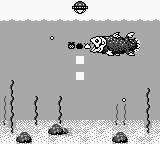
The level 20 Hi film has a twist the NES version lacks. The UFO turns up as before and starts to beam the viruses away, but a coelacanth swims through and swallows them, and the flying saucer leaves empty-handed.
Level 5 on Hi: the pufferfish.Level 10 on Hi: the crab.Level 20 on Hi: the UFO and the coelacanth.
2 Player Game
Two bottles side by side, each with its own level and speed. Matches go to the first player to win three rounds, and the rules are as described in the gameplay section above. It was the mode reviewers singled out in 1990 for its handicapping, and it is the one Nintendo Switch Online lets you play over the internet.
A two-player match on the NES.
In the arcades: VS. Dr. Mario and PlayChoice-10
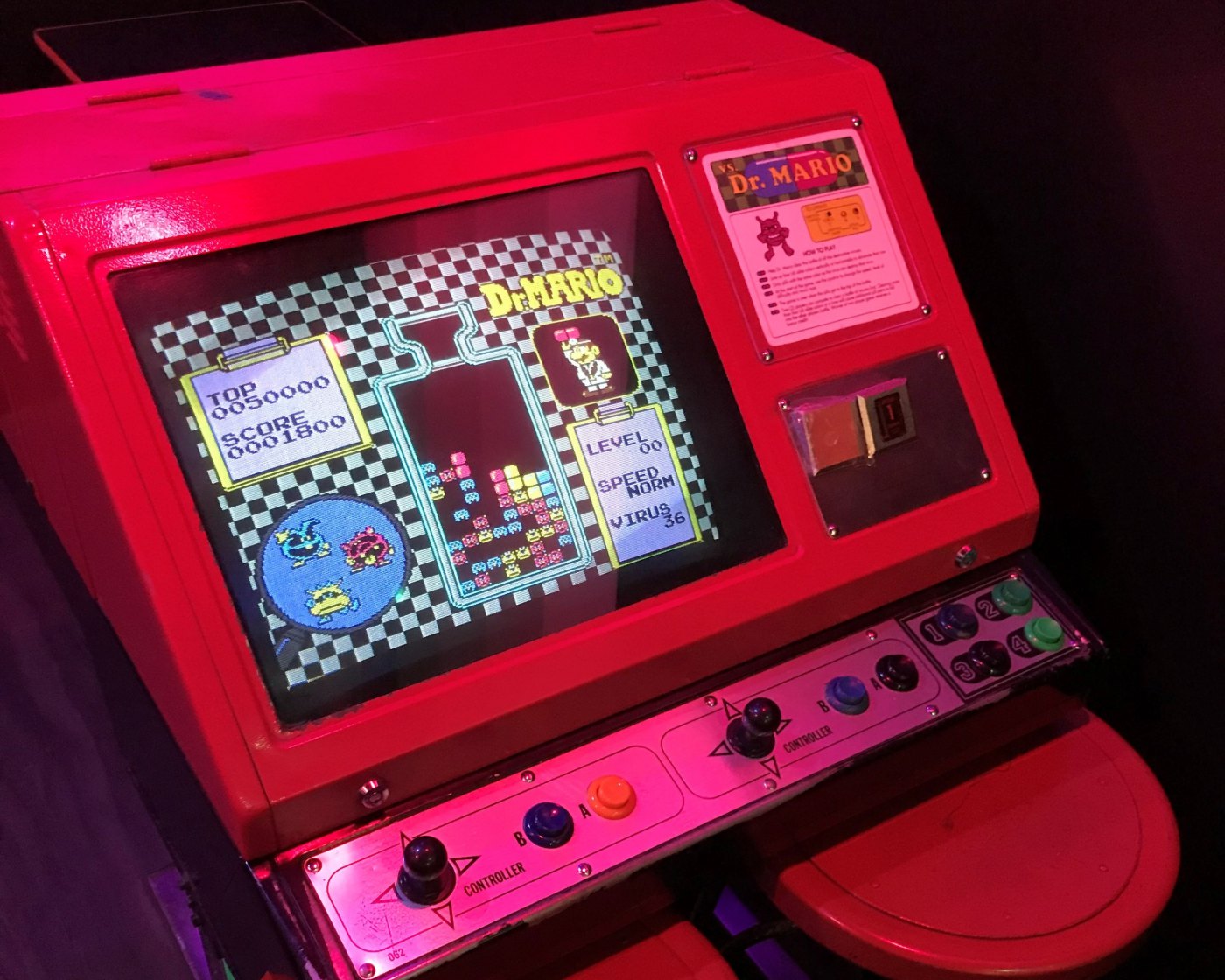
Nintendo also took the game to American arcades in August 1990, showing it first at its seventh annual distributor meeting in San Diego. The PlayChoice-10 cabinet ran the NES game on paid-for time; VS. Dr. Mario for the VS. System was reworked for coin-op play.
The VS. game drops the Low speed, renames Med as Norm (on a grey background) and paints Hi purple. The options screen gives you just 20 seconds, the music cannot be switched off, and the scoring is meaner: at normal speed each extra virus in a combo adds a flat 200 points instead of doubling the value. It is the one VS. System Mario game that has not been reissued in the Arcade Archives line.
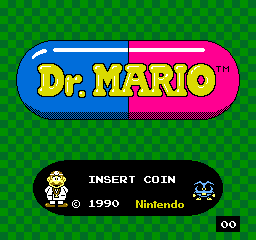
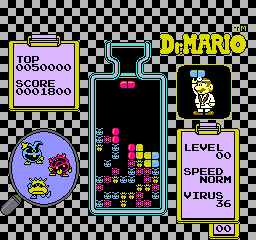
The VS. Dr. Mario title screen.VS. Dr. Mario in play.A VS. Dr. Mario cabinet.
Dr. Mario: The UFO cover-up.
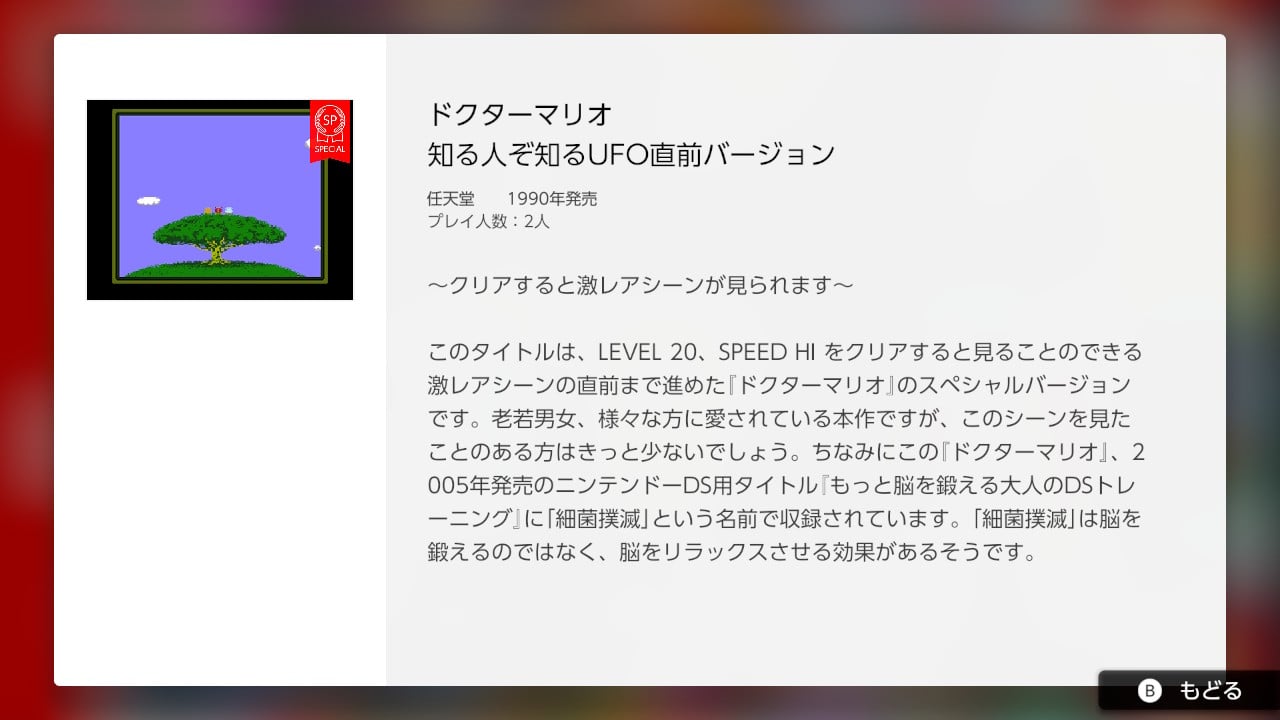
On 12 December 2018 Nintendo Switch Online added a special edition of the NES game that starts at level 20 on Hi, a straight shot at the UFO film. Its Japanese name, roughly “the just-before-the-UFO version that only those in the know know”, gives the joke away.
The Japanese introduction to the Switch Online special edition.
Every reward film in Dr. Mario
Fifteen films across the two versions, with the level and speed that unlock each one.
CongratulationsNES · level 20, LowJust a message on a black screen and a slowed-down ending tune.
The flying bookNES · level 5, MedA book flaps its covers across the sky from left to right.
The roosterNES · level 10, MedA rooster labours slowly from right to left.
The spray canNES · level 15, MedAn upside-down aerosol rockets past on its own spray.
The dinosaur in an eggNES · level 20, MedA dinosaur sits in its egg and paddles slowly across.
The tortoiseNES · level 5, HiA tortoise swims through thin air.
The propeller pigNES · level 10, HiA pig whirls its tail and flies.
The witchNES · level 15, HiA witch crosses the sky on her broom.
The UFONES · level 20, HiNight falls, the music stops and the viruses are abducted. Then it rains stars.
The sea floorGame Boy · level 20, LowThe viruses sit on the sea bed, and that is all.
The nautilusGame Boy · level 20, MedA nautilus drifts slowly past.
The pufferfishGame Boy · level 5, HiA fully puffed-up pufferfish floats by.
The crabGame Boy · level 10, HiA crab dashes sideways along the bottom.
The flying fishGame Boy · level 15, HiA flying fish skims over the waves above.
The UFO and the coelacanthGame Boy · level 20, HiThe UFO comes for the viruses, but an ancient fish eats them first.
TCRF found graphics for a snowman in boots in the NES cartridge, filed where the level 20 Hi film’s sprites would be, along with a round object that could be a football or a meteor. They were never used.
Advertisement
Gameplay & Controls
Dr. Mario takes a minute to learn and a long time to master. Here is everything the game asks of you, from the buttons to the scoring table.
Controls
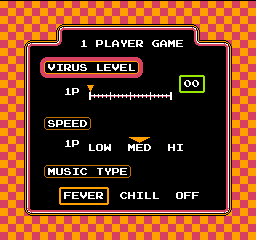
The pad moves the falling capsule left and right, and pressing down drops it faster. A turns it clockwise and B anticlockwise, so a capsule can be stood on end or laid flat and its colours swapped round. Start begins a game and pauses it; Select and the pad move through the menus. The controls are the same on the NES and the Game Boy.
The NES options screen: virus level, speed and music.
The bottle, the capsules and the viruses
The playing field is a medicine bottle eight squares wide and sixteen tall. Viruses come in red, blue and yellow, and every capsule is made of two halves, each of which can be any of the three colours, so a capsule can be one colour all over or any mix of two.
Four or more matching segments in a horizontal or vertical line disappear, along with any virus among them. Once a match clears, any capsule half left without support drops, and if it lands in another line of four the clearing carries on. Diagonals never count.
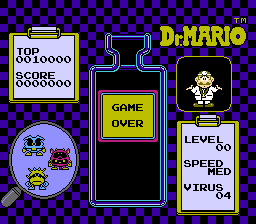
The game ends when the pile blocks either of the two squares at the top centre of the bottle, where new capsules enter. Partway through a level a five-note chime warns that capsules have started falling faster.
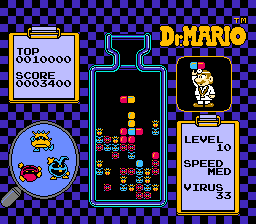
Level 10 on the NES: 44 viruses to clear.Blocked at the neck: game over on the NES.
Levels, speeds and scoring
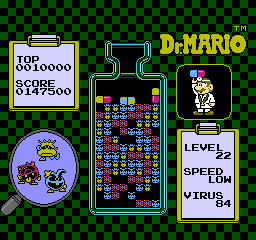
Before each game you pick a virus level from 0 to 20 and a speed. The number of viruses is four times the level plus four, so level 0 has four germs and level 20 has eighty-four. Clear a bottle and the next level begins, with the score carried over. On the NES the count stays at 84 beyond level 20.
Speed (Low, Med or Hi) sets how quickly capsules fall and how much each virus is worth. Only viruses score: one virus is worth 100 points on Low, 200 on Med and 300 on Hi, and the more viruses destroyed at once, the more they earn. The manual’s table doubles the value with each extra virus, up to 3,200, 6,400 or 9,600 for six, and destroying more than six at once scores only as six. Clearing capsules alone, or dropping them quickly, earns nothing.
Viruses destroyed at once
Low
Med
Hi
1
100
200
300
2
200
400
600
3
400
800
1,200
4
800
1,600
2,400
5
1,600
3,200
4,800
6 or more
3,200
6,400
9,600
Level 22 on the NES: the count stays at 84.
Fever and Chill
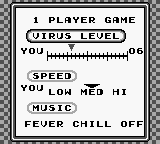
The third option on the menu is the music: Fever, Chill, or Off for anyone who needs to concentrate. On the Game Boy you can hear each track by highlighting it before you start, which the NES version does not allow. Both were written by Hirokazu Tanaka, and both have been rearranged many times since.
The Game Boy options screen, where the tunes can be previewed.
Two-player VS
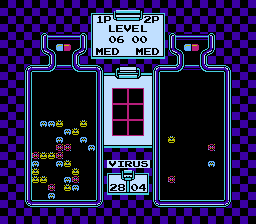
In the two-player game each player has a bottle and picks their own virus level and speed, a built-in handicap that lets a beginner take on an expert. You win a round by clearing your bottle first, or when your opponent’s pile reaches the top. The first to three round wins takes the match.
Attacks come from combos. Clear two or more lines in one move and the same number of loose capsule halves (four at most), in the colours you cleared, drop into your rival’s bottle, falling at roughly Hi speed. Two pieces always land four columns apart and three land two columns apart, so they spread awkwardly across the bottle. The Game Boy version needs two cartridges and a Game Link cable.
Two-player VS on the NES.
Capsules and viruses
Everything that goes into the bottle.
Vitamin capsuleTwo halves, each red, blue or yellow. Turn it with A and B and drop it with down on the pad.
Red virusCleared by red segments. Present from level 0.
Blue virusCleared by blue segments.
Yellow virusCleared by yellow segments.
Loose halfWhat is left when the other half of a capsule is cleared. It falls if nothing holds it up, which is how chains happen.
Attack piecesTwo-player only. Single halves dropped into the other bottle when a player clears two or more lines at once.
Cartoons, Comics & Other Media
Dr. Mario left the hospital almost at once: into comics within months, and later into Smash Bros., WarioWare and a cereal box.
The Doctor Is In… Over His HeadNintendo Comics System · 1990This comic sent Mario to work as assistant to a Dr. Waldo Bloom, where he is addressed as Dr. Mario.
Super Mario-kunManga · from 1990The long-running comic gave Mario the doctor’s outfit and capsules as a recurring gag.
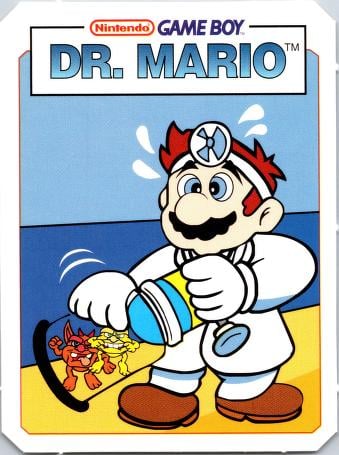
Kellogg’s Nintendo collector cardsCereal promotionDr. Mario featured on cards and a sticker in Kellogg’s Nintendo series.
Super Smash Bros. MeleeGameCube · 2001Dr. Mario became an unlockable fighter, throwing capsules, with Fever on the soundtrack. He returned in the 3DS and Wii U games and in Ultimate; in Brawl he was only a sticker, while Chill was arranged for the Flat Zone 2 stage.
WarioWare microgames2003–2023WarioWare, Inc.: Mega Microgame$! has a Dr. Mario microgame and an unlockable Dr. Wario spoof; WarioWare Gold remade it with twist controls and WarioWare: Move It! has another.
NES Remix 2 and Ultimate NES RemixWii U and 3DS · 2014Dr. Mario is the final challenge of the Championship Mode.
Super Smash Bros. for Wii U2014A timed trial of the Game Boy version is one of the unlockable Masterpieces.
Mario Kart TourMobile · 2022Dr. Mario and Dr. Luigi raced in the Doctor Tour, with the capsule as Dr. Mario’s special item.
Pikmin BloomMobile · May 2026A Game Pak decor event dressed White Pikmin in the Famicom cartridge of Dr. Mario, posed like the capsule-holding artwork.
Characters
A small cast: one doctor, his nurse (offstage), and a great many germs.
Character
Who they are
In this game
Abilities & notes
Dr. MarioThe doctor
Mario in a white coat, head mirror and stethoscope. This game is his first appearance.
The only character on screen, standing beside the bottle and throwing in each capsule.
Sprite on both versions (NES in colour, Game Boy in greys)
Later a playable fighter in Super Smash Bros.
Nurse ToadstoolThe nurse
Princess Toadstool (Peach) cast as a nurse at the Mushroom Kingdom Hospital.
Raises the alarm in the back-story when the viruses get loose. She appears in Nintendo’s artwork, not in the game itself.
Not playable
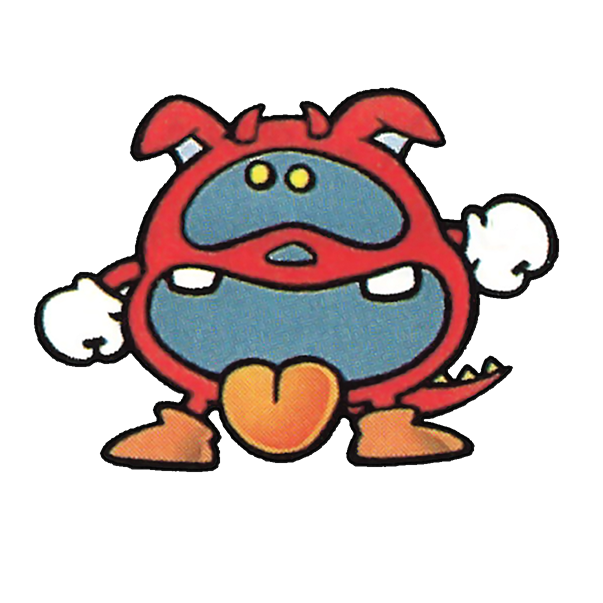
Red virusVirus
A grinning red germ, one of the three that escape from the lab.
Scattered through the bottle from the start; its magnified twin dances in the corner panel on the NES.
Cleared by red
Also known as Fever
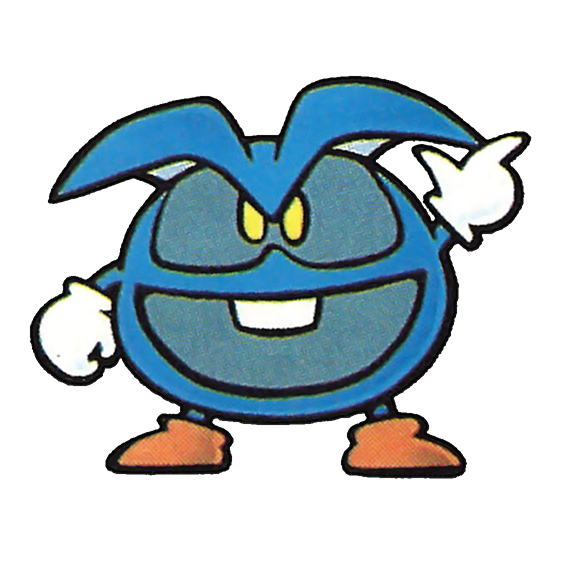
Blue virusVirus
The blue germ, drawn with a scowl.
As above, in blue.
Cleared by blue
Also known as Chill
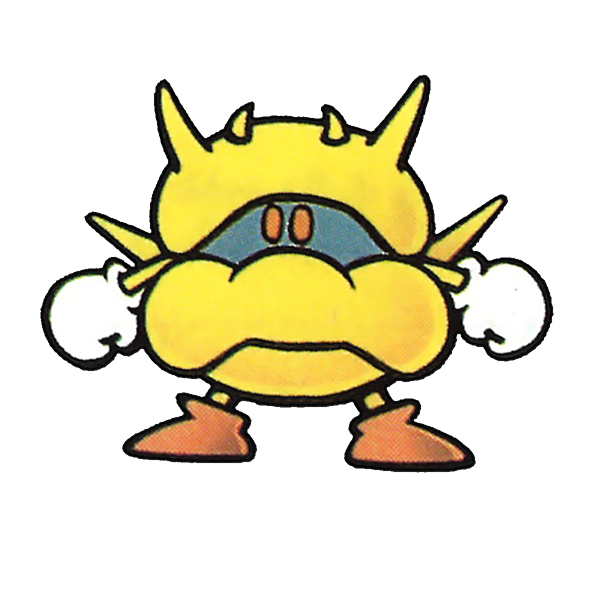
Yellow virusVirus
The yellow germ, with plump cheeks. In the prototype it had a trumpet-shaped snout.
As above, in yellow.
Cleared by yellow
Also known as Weird
The viruses on both systems
On the NES the germs are red, blue and yellow; the Game Boy tells them apart by shade instead.
Red virusNESSprite used in the bottle.
Blue virusNESSprite used in the bottle.
Yellow virusNESSprite used in the bottle.
The laughing trioNESThe three viruses in their laughing animation.
Black virusGame BoyThe darkest of the three monochrome germs.
Grey virusGame BoyThe middle shade.
White virusGame BoyThe lightest, outlined in black.
The Game Boy trioGame BoyAll three dancing in the status panel.
The people who made it
Nintendo R&D1 staff as given by Wikipedia and other references (only Harada’s role is well sourced):
Takahiro HaradaMain programmer; listed as a directorLater the producer of Wario Land: Shake It!
Gunpei YokoiProducerThe creator of the Game & Watch and the Game Boy. Some staff lists also name him as game designer.
Hirokazu TanakaMusic and soundComposer of Fever and Chill.
Hitoshi YamagamiDirector (unconfirmed)Named alongside Harada in some staff lists.
Hiroshi YamauchiExecutive producerNintendo’s president at the time.
How It Was Made
No making-of has ever been published for Dr. Mario, so this account is pieced together from the credits, the cartridges and the prototype.
Nintendo’s own Tetris
Dr. Mario at work, in Nintendo’s artwork.
Dr. Mario came from Nintendo R&D1, produced by Gunpei Yokoi, the man behind the Game & Watch and the Game Boy, with Takahiro Harada as its programmer. Its timing was no accident. Tetris was a hit for Nintendo, but its rights were licensed and limited, and Inverse’s 35th-anniversary piece describes Dr. Mario as both an answer to that hit and a hedge against it: a falling-piece game Nintendo could control outright.
Henk Rogers, who had worked with Yokoi to bring Tetris to the Game Boy, was not amused. He has said in interviews (Retro Gamer in 2018, PC Gamer in 2025) that he saw it as a fairly naked attempt at a second Tetris, and not as good a one, though he says he has since forgiven Yokoi.
From Virus to Dr. Mario
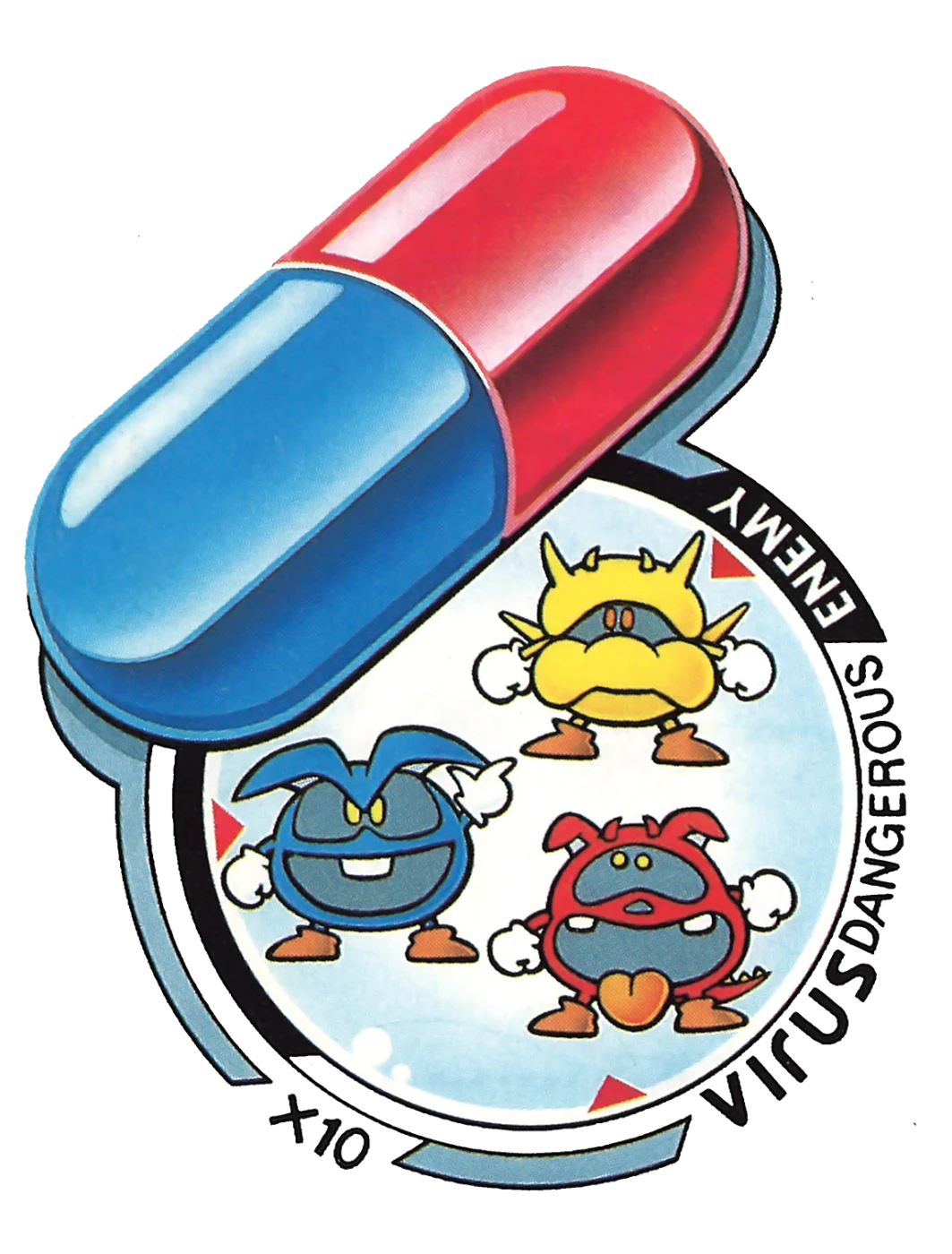
The viruses in the artwork used on the Japanese box.
The game started out under the plain working title Virus. Images of the prototype shared online show similar rules, but the patient was a sick animal rather than a bottle, a nurse who looks like Nurse Toadstool was already there, and the yellow virus had a downward-pointing trumpet of a nose instead of its chubby cheeks.
The NES cartridge holds more clues. TCRF found many leftover routines and variables from the Famicom Disk System’s BIOS in the code, suggesting the game began life as a disk game, and a disabled demo-recording mode that could only have worked from a writable disk. It also found a sprite of half a big capsule, added after a PlayChoice-10 build still called Virus, and a colourful line effect that looks like an early version of the virus-clearing animation.
Fever and Chill
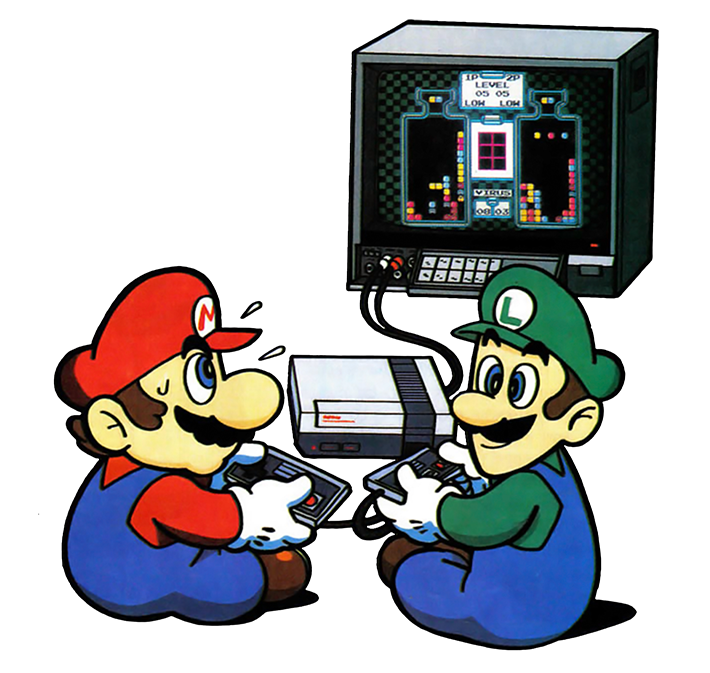
Mario and Luigi playing the game, in artwork from Nintendo Power.
The music is by Hirokazu Tanaka. He gave the game just two in-game tunes and made them count: both themes are in the Nintendo Music app today, the Game Boy soundtrack since the app launched and the NES one since March 2025, and both have been arranged for Super Smash Bros.
Two systems, two arcades
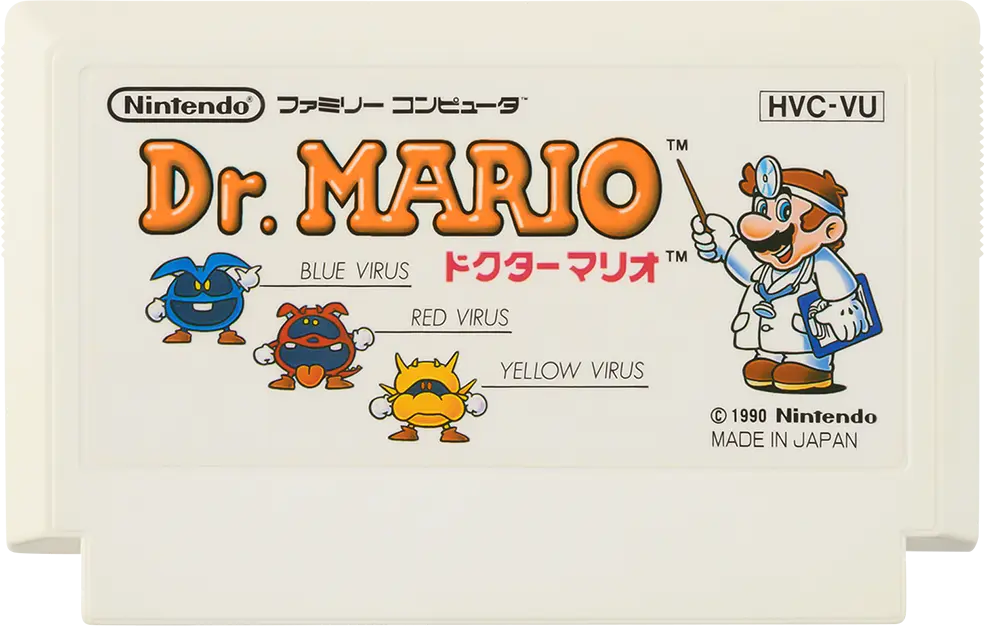
The Famicom cartridge.
Nintendo released the Famicom and Game Boy versions in Japan on the same day, 27 July 1990. In America the arcade versions came first: VS. Dr. Mario and the PlayChoice-10 edition were shown at Nintendo’s seventh annual distributor meeting in San Diego and released in August. The NES cartridge followed in October, and Europe waited until 1991.
The NES game also carries a piece of anti-piracy code. When it boots, it adds up the title screen data, and if the total is wrong every capsule that lands sends the game into a crash.
Advertisement
Series Firsts
Only firsts we could find stated in a source are listed.
1Dr. Mario’s debutThe doctor himself, his capsules and the three-colour viruses all first appeared here, the start of the Dr. Mario series.
2Fever and ChillHirokazu Tanaka’s two themes, later arranged for Smash Bros. and the sequels.
Cheats & Secrets
There are no button codes in Dr. Mario, but there is plenty worth knowing.
Where the films are
Clear level 5, 10, 15 or 20 on Med or Hi for the NES films (only level 20 on Med, and 5 to 20 on Hi, on the Game Boy). The UFO needs level 20 on Hi. You can start at level 20, so the UFO is one bottle of 84 viruses away.
Speed means points
Every virus is worth three times as much on Hi as on Low, and the more viruses you destroy at once the more they pay: six at once on Hi is the top line of the manual’s table, at 9,600 points. Only viruses score.
Use the handicap
In two-player games each side chooses its own level and speed, so a stronger player can take on more viruses at a faster speed.
Hear the tune first
On the Game Boy, highlighting Fever or Chill on the options screen plays it, so you can pick by ear.
Game Genie oddities
TCRF found two settings left over from the Virus prototype that cheat devices can switch on: leftover halves that hang in mid-air instead of falling, and a two-player match length other than three wins.
The UFO cover-up
On Nintendo Switch Online, the special edition starts you at level 20 on Hi.
Glitches & Oddities
Few glitches are documented for Dr. Mario, but the Game Boy version goes strange past level 20.
Game Boy levels beyond 20
The Game Boy cartridge keeps going after level 20, but some of the later virus layouts may be impossible to finish, and level 28 is reportedly a kill screen on which Mario does not appear. TCRF notes that the first release had 24 levels and looped the 24th, while a revision added six more and loops level 30; a virus-related bug can softlock the game past roughly level 20.
The anti-piracy crash
Not a bug but deliberate: a copied or altered NES cartridge whose title screen data fails the start-up check crashes the moment a capsule lands.
Videos
Nintendo’s trailer for the Game Boy version’s arrival on Switch Online, and a third-party video review of the NES original.
Official upload: the March 2024 trailer that added Dr. Mario, Mario Tennis and Mario Golf to the Game Boy library.
Third-party review of the NES version with gameplay footage.
Trivia & Interesting Facts
The working title was simply Virus, and in the prototype the patient was a sick animal.
The finished yellow virus.The yellow virus had a trumpet-shaped snout in the prototype; the finished game gave it plump cheeks.
Code from the Famicom Disk System’s BIOS survives in the NES cartridge, a hint that the game was first built as a disk game.
An unused snowman in boots, with its own tilemap and programmed behaviour, is filed among the NES film sprites next to the UFO scene’s.
The coelacanth gets there first.On the Game Boy the UFO is upstaged by a coelacanth, which eats the viruses before they can be beamed up.
The 3DS Virtual Console release of the Game Boy version has no two-player mode, since the original needed a link cable.
The Game Boy version has a special fanfare for clearing four or more lines in one move, which the NES version lacks.
In Japan the game is Dokutā Mario; the Switch Online special edition’s French name is Dr. Mario: Conspiration extraterrestre.
VS. Dr. Mario is the only VS. System Mario game that has not appeared in the Arcade Archives series.
Mario and Luigi at the controls.Nintendo Power’s artwork for the game included Mario and Luigi sitting down to play it themselves.
Henk Rogers, who helped bring Tetris to the Game Boy, has said he was angry when he first heard about Dr. Mario.
The Game Boy version became a Nintendo Switch Online extra in Animal Crossing: New Horizons with the 3.0 update in January 2026.
Dr. Mario was absent as a fighter from Super Smash Bros. Brawl, appearing only as a sticker, but data suggests he had been planned.
The Classic Tetris World Championship ran a Dr. Mario side event in 2018.
Regional Box Art
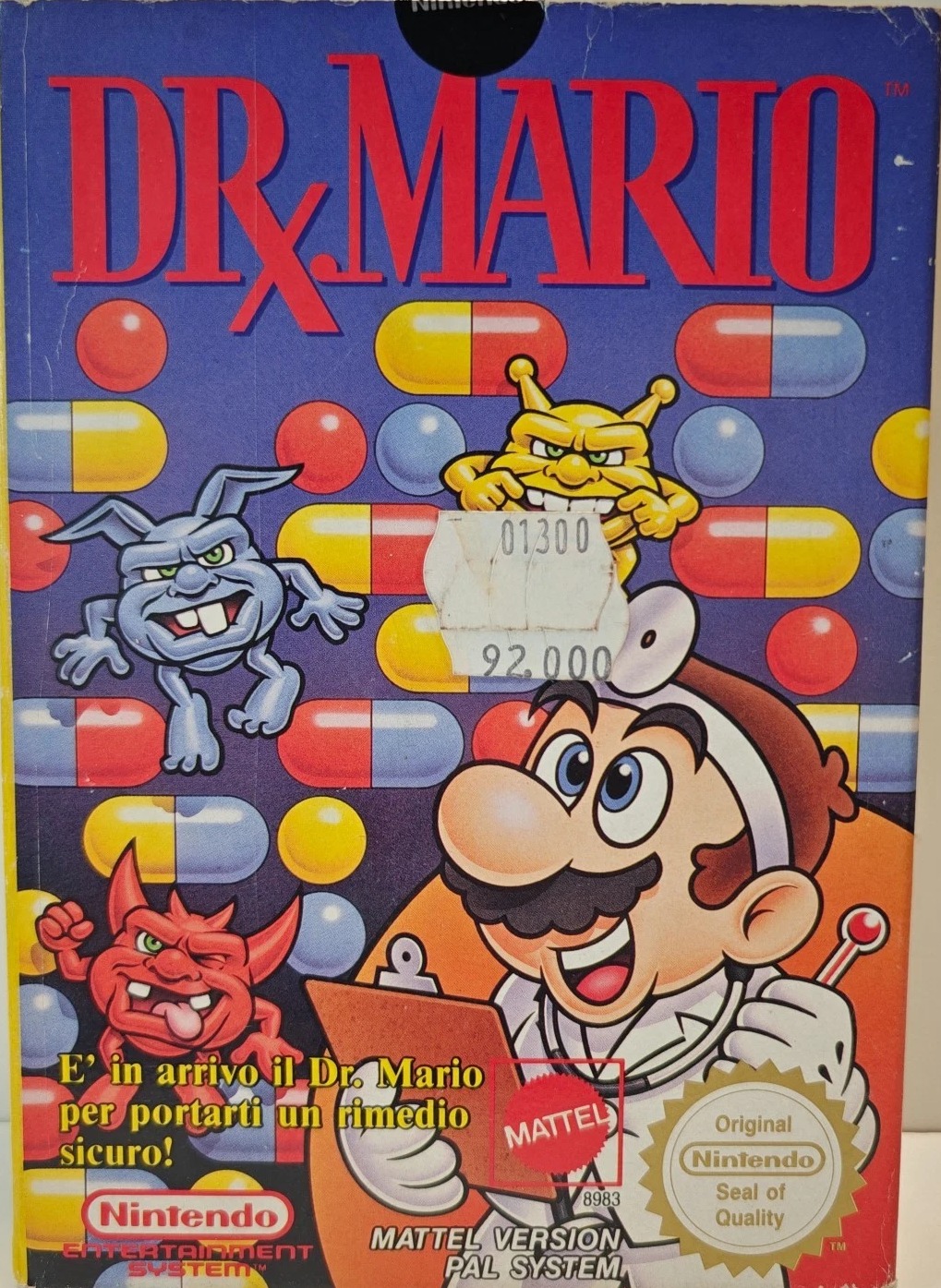
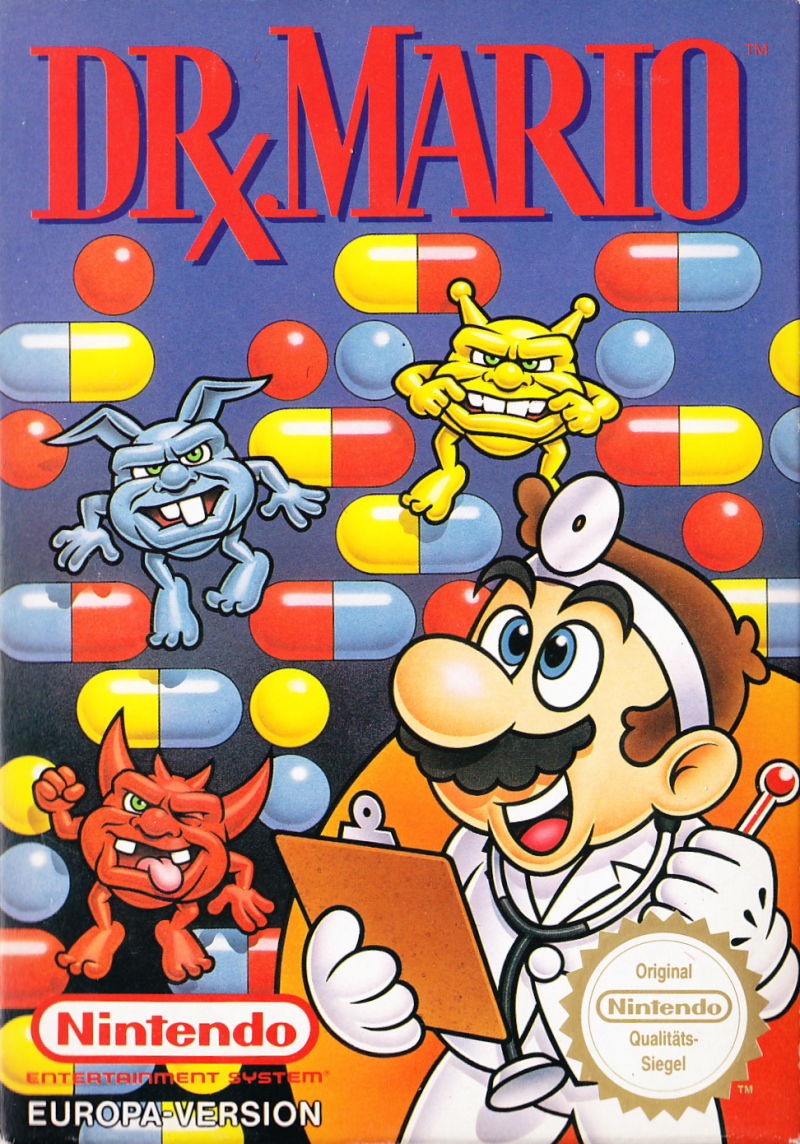
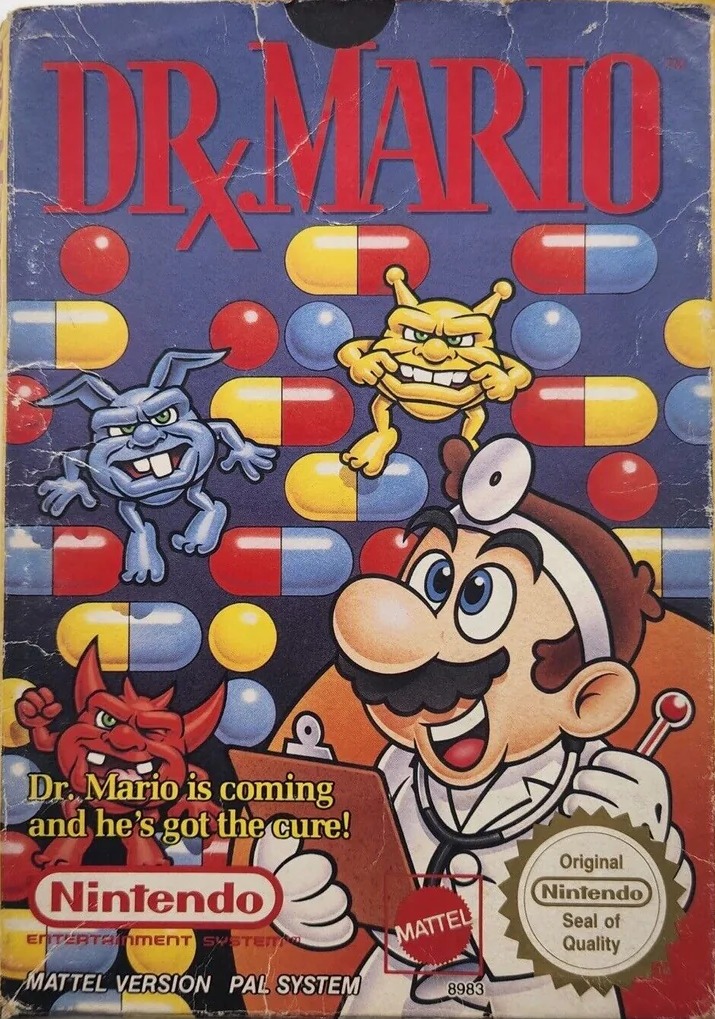
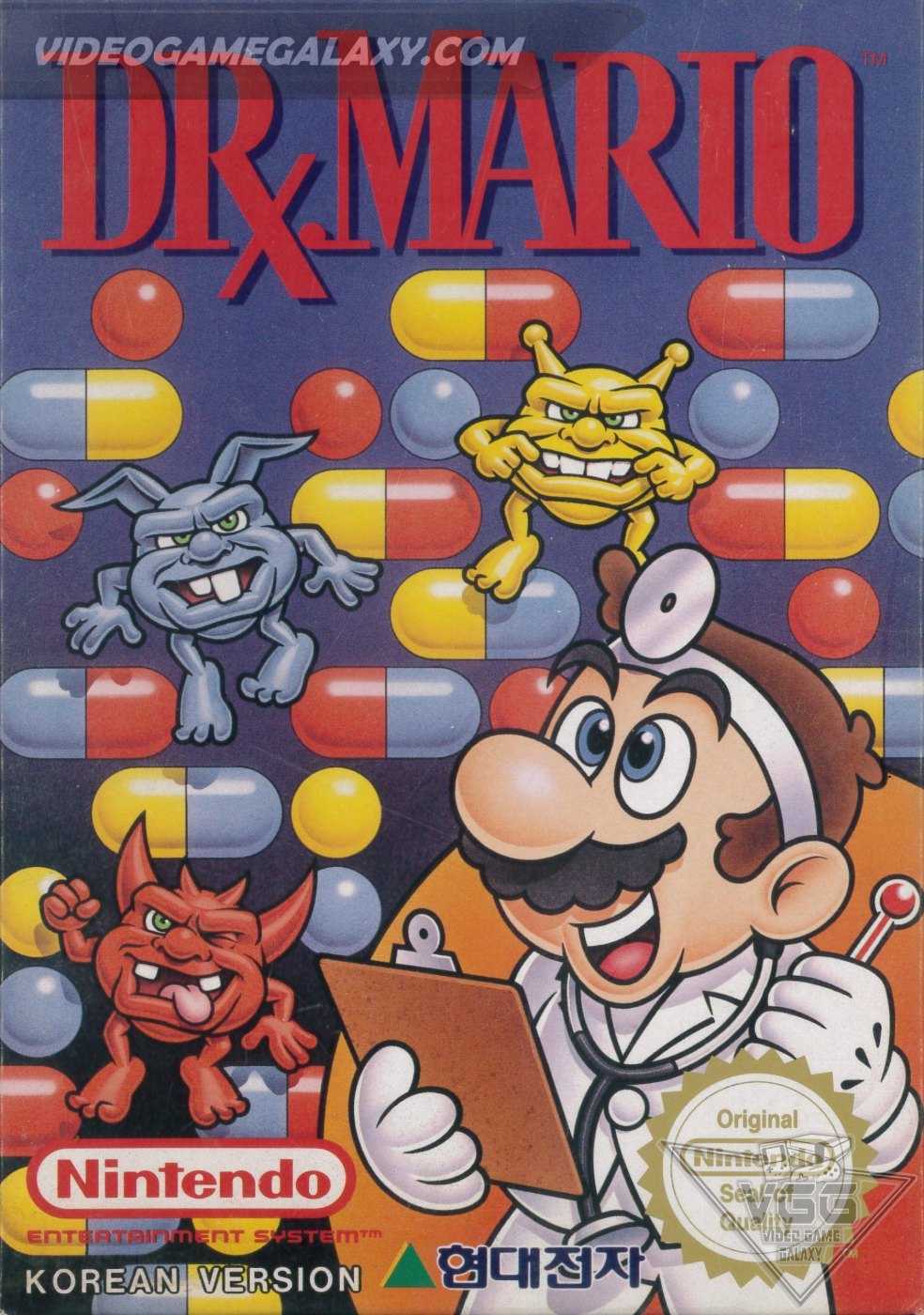
Two formats, a dozen countries and several reissues. Many of the early European NES and Game Boy boxes share the same design with different rating and language marks.
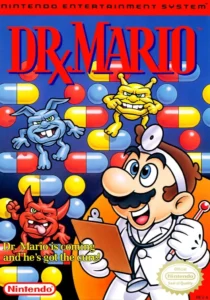
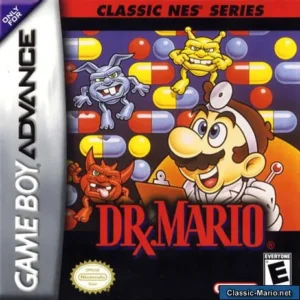
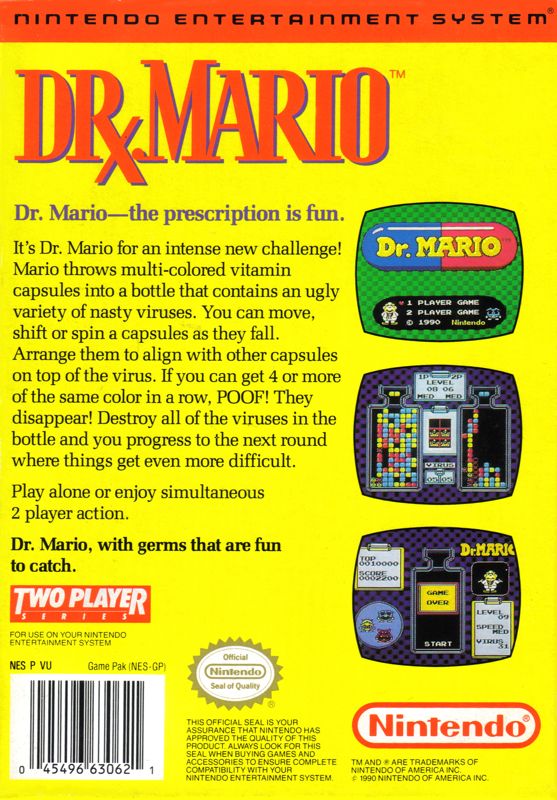
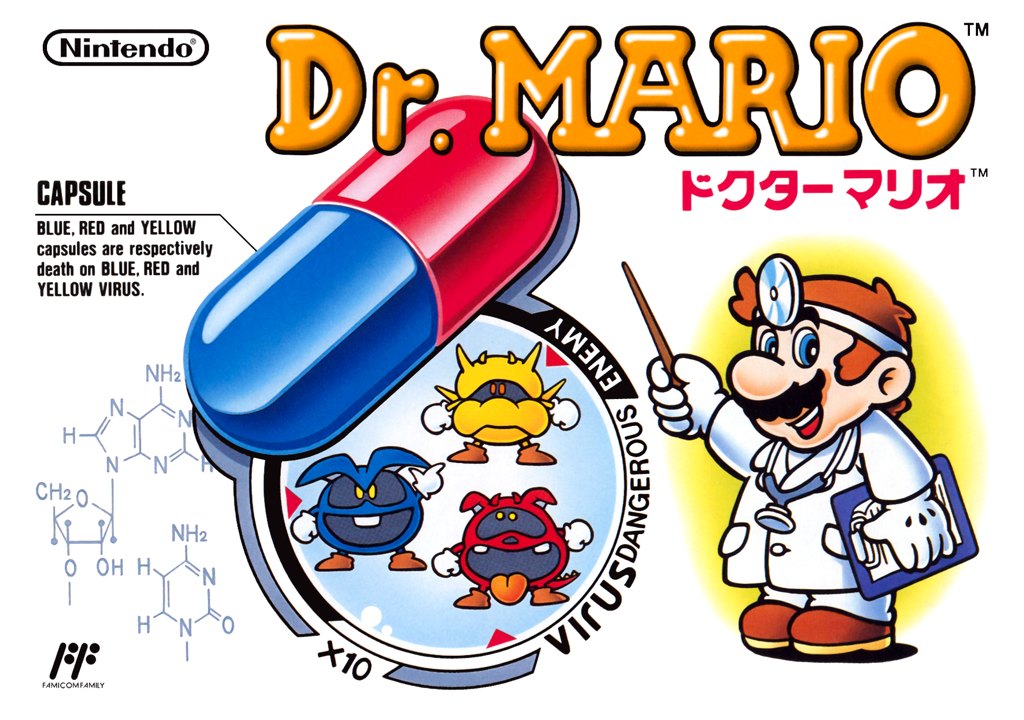
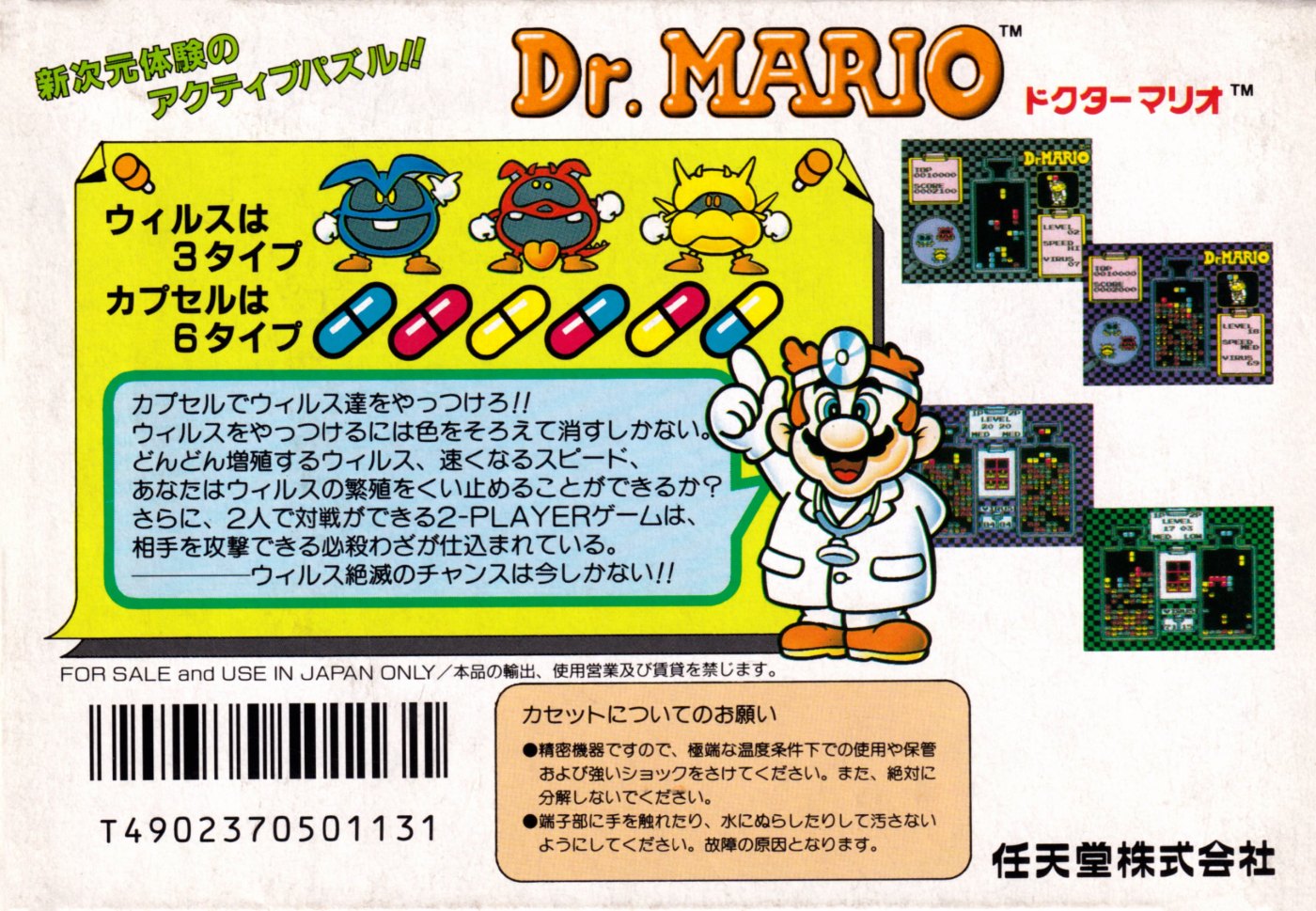
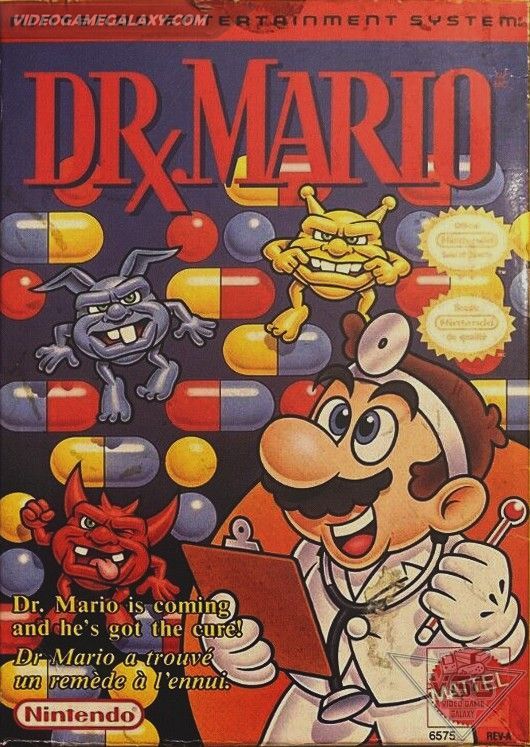
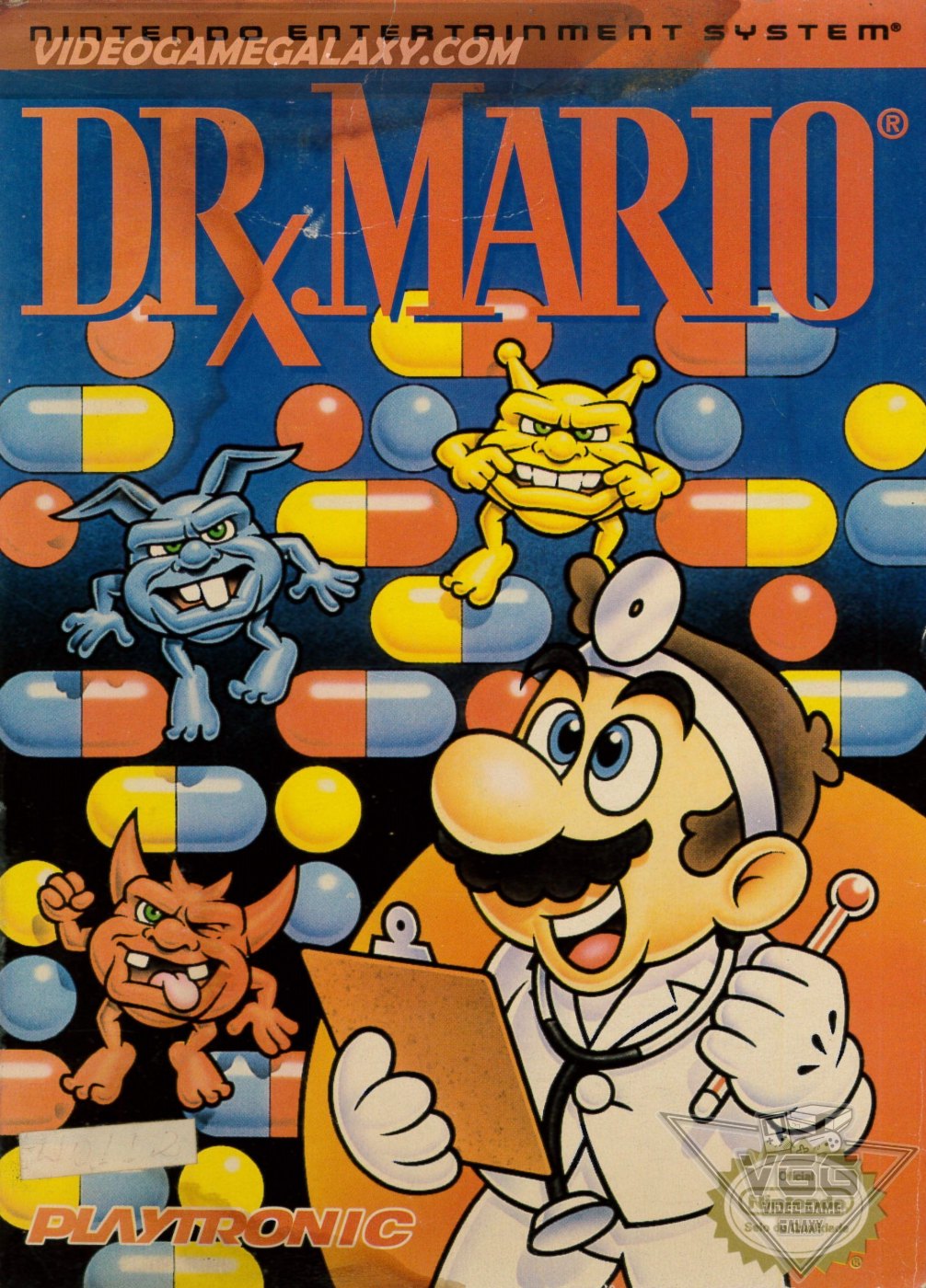
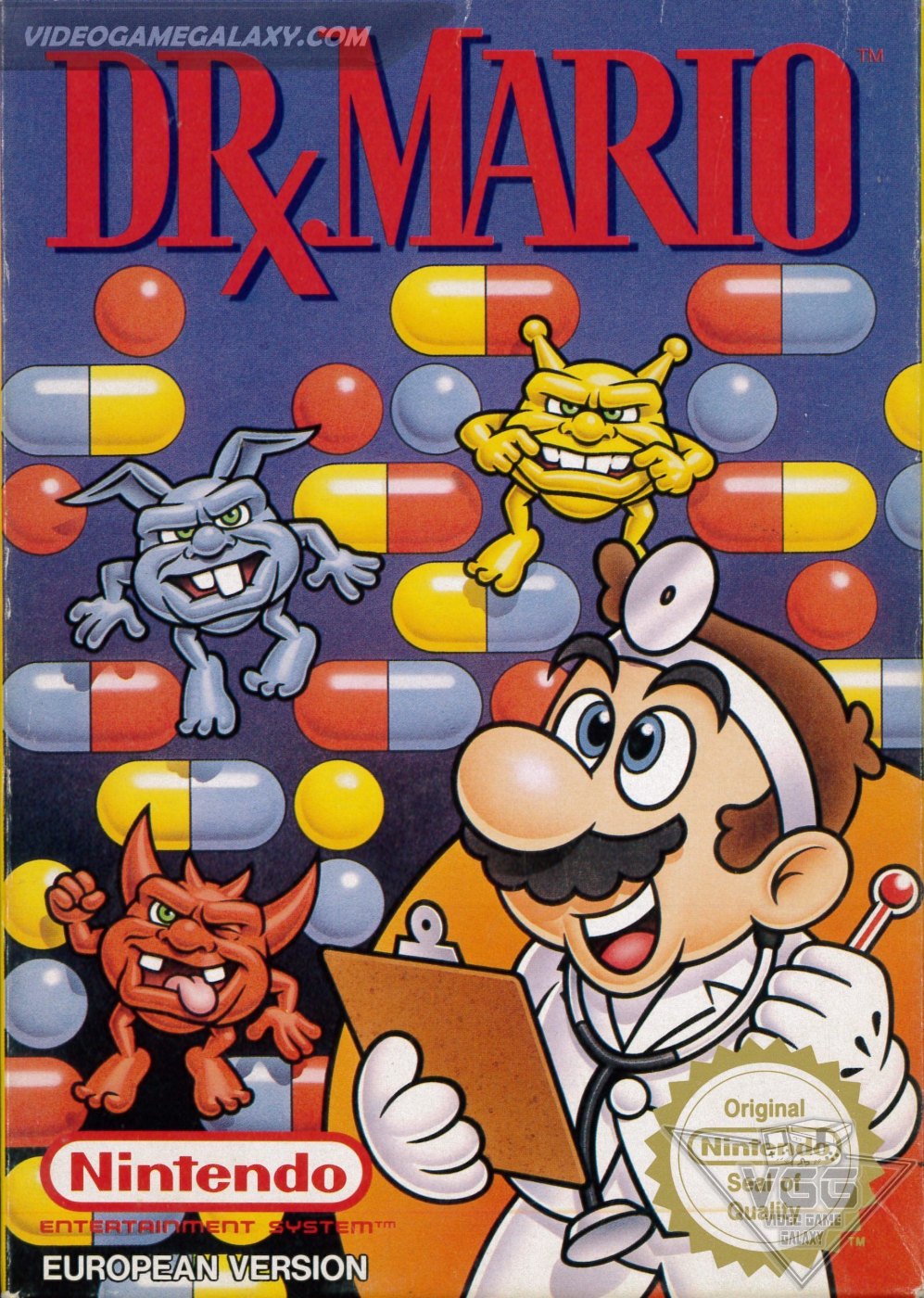
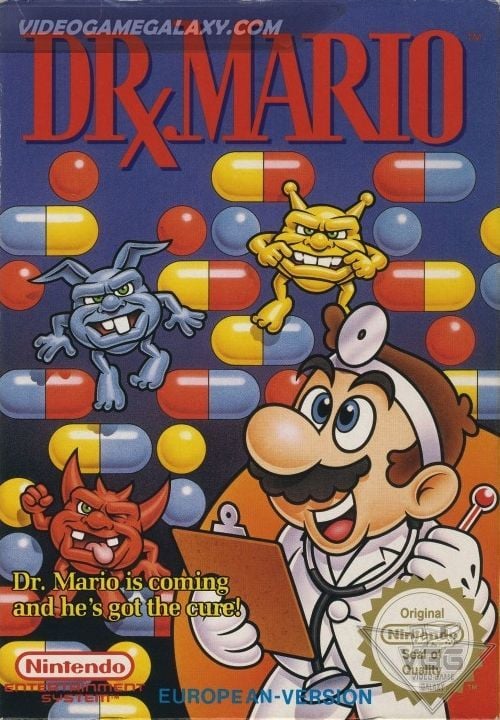
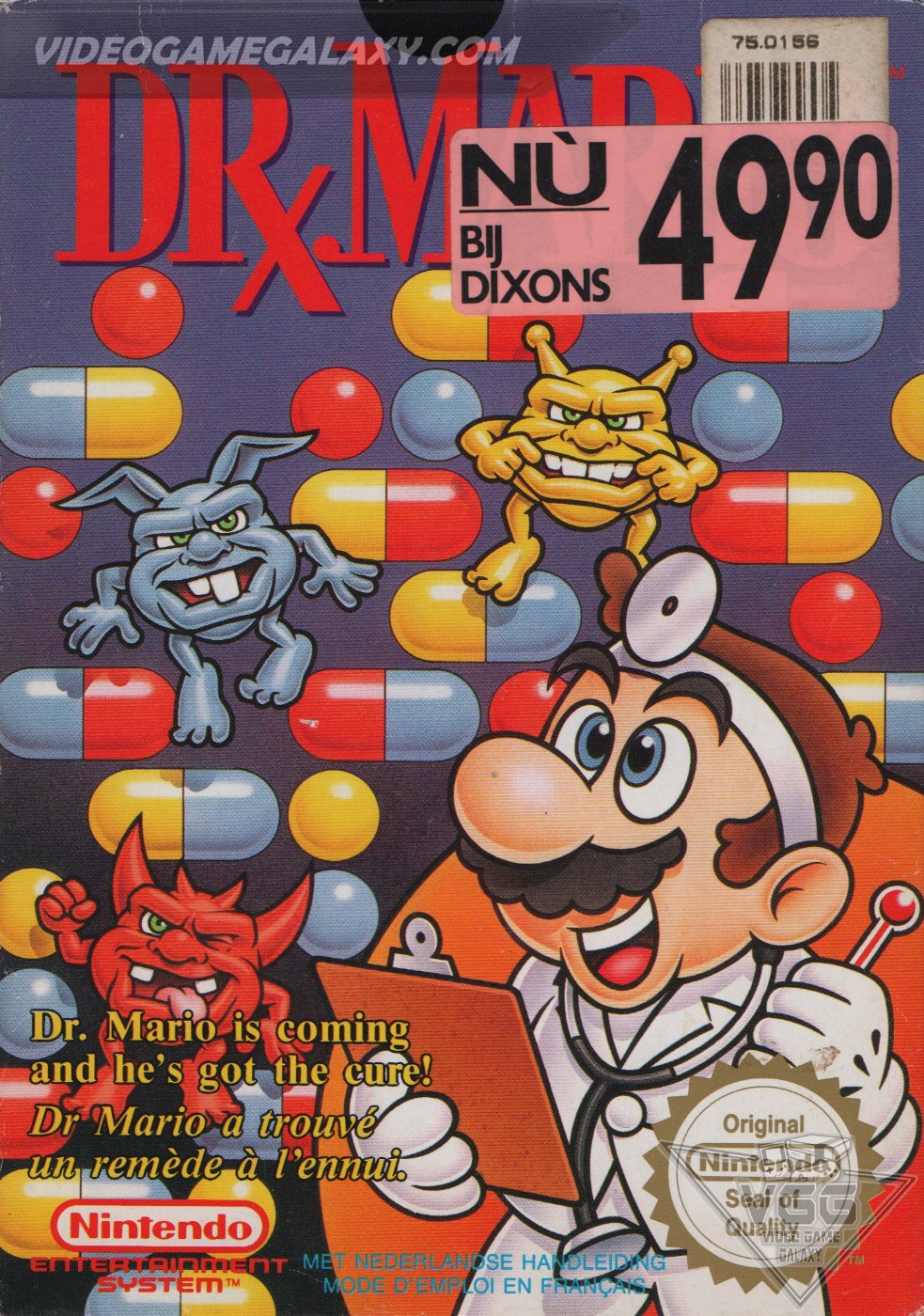
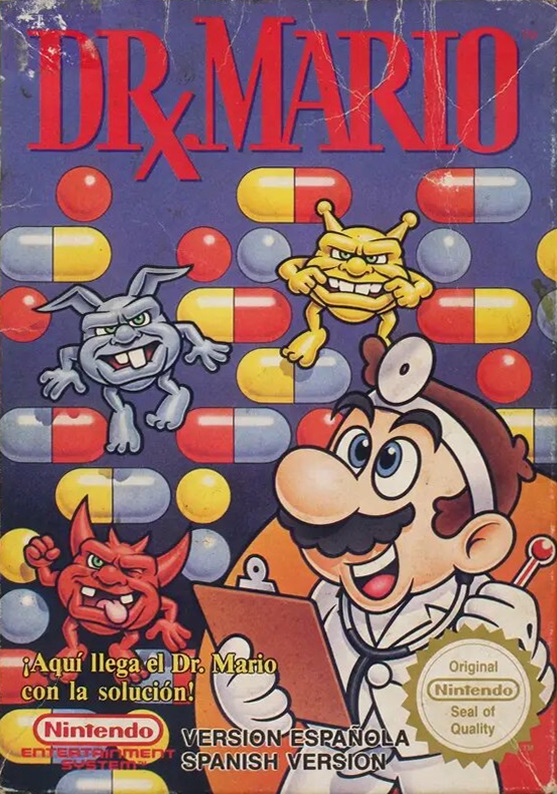
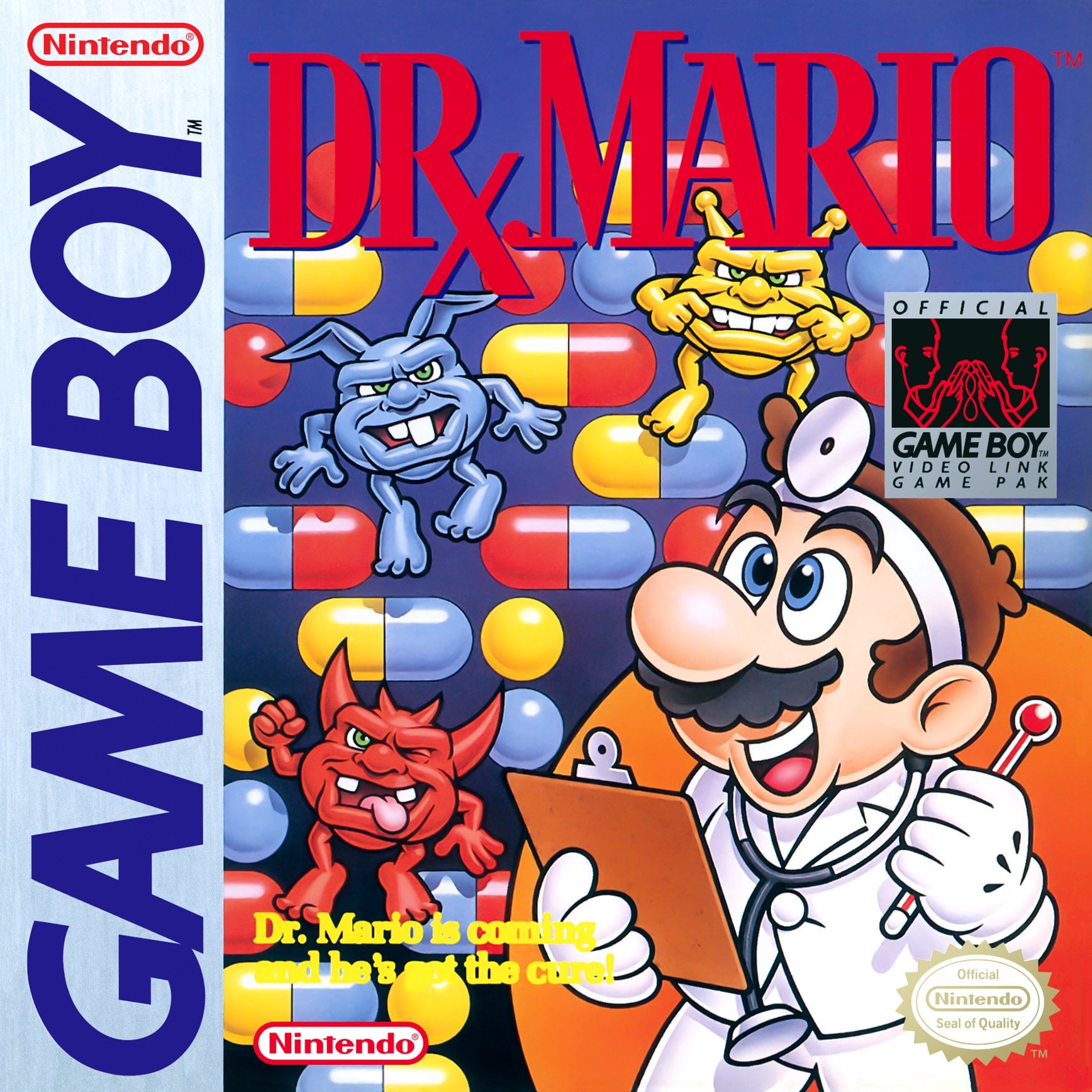
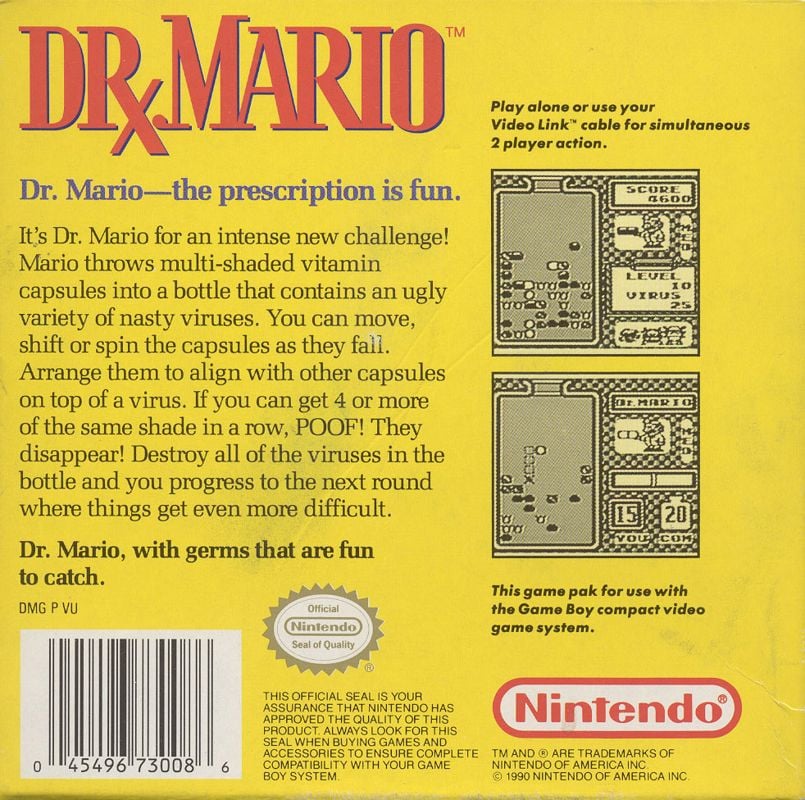
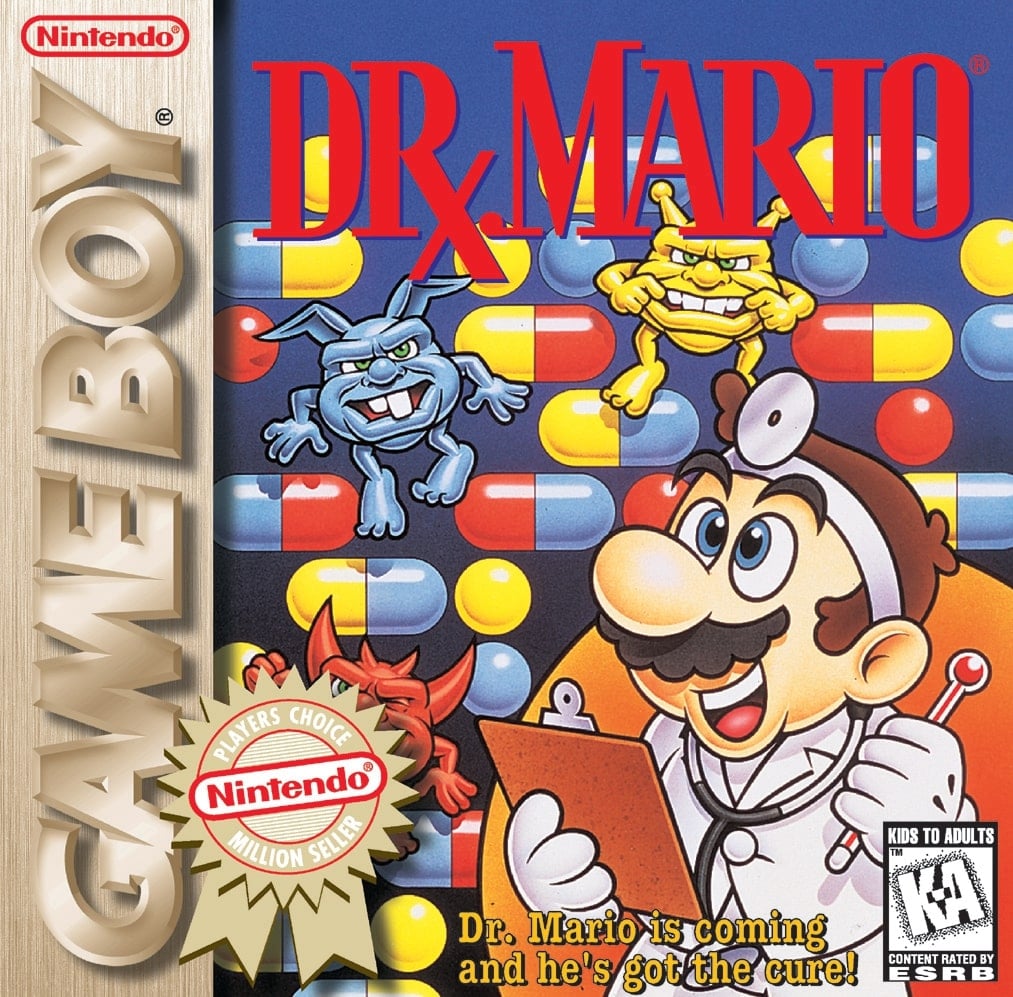
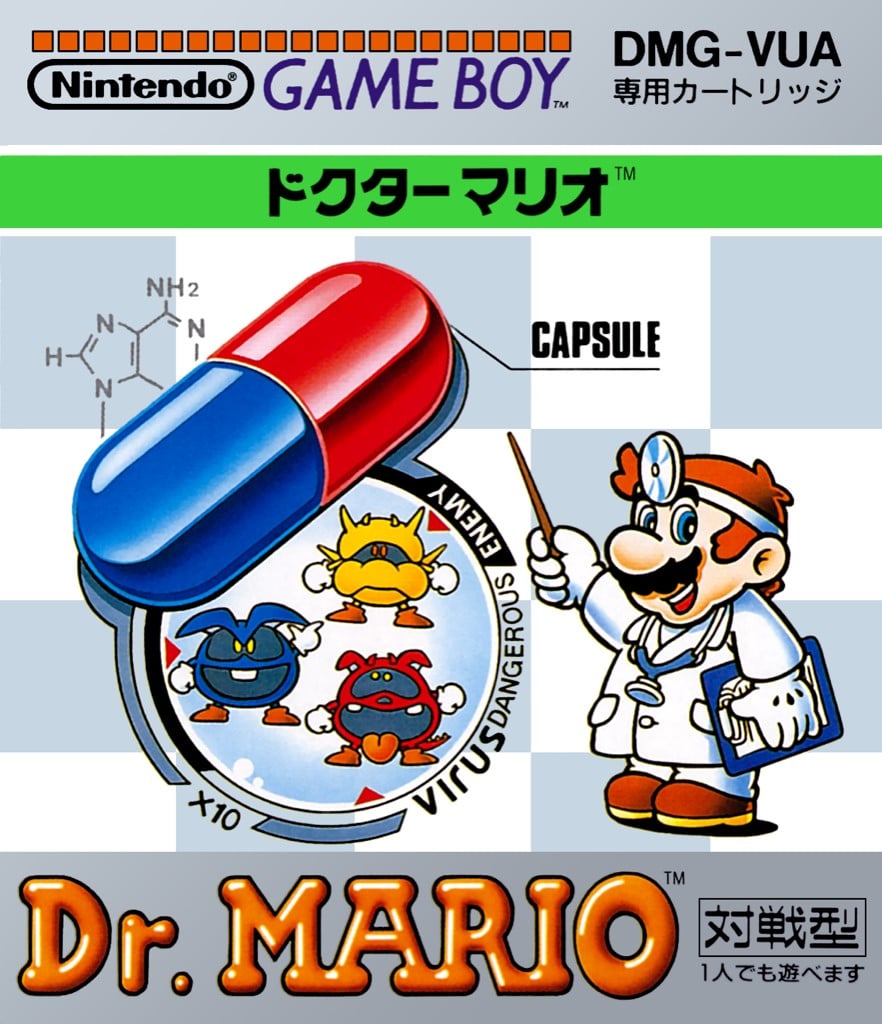
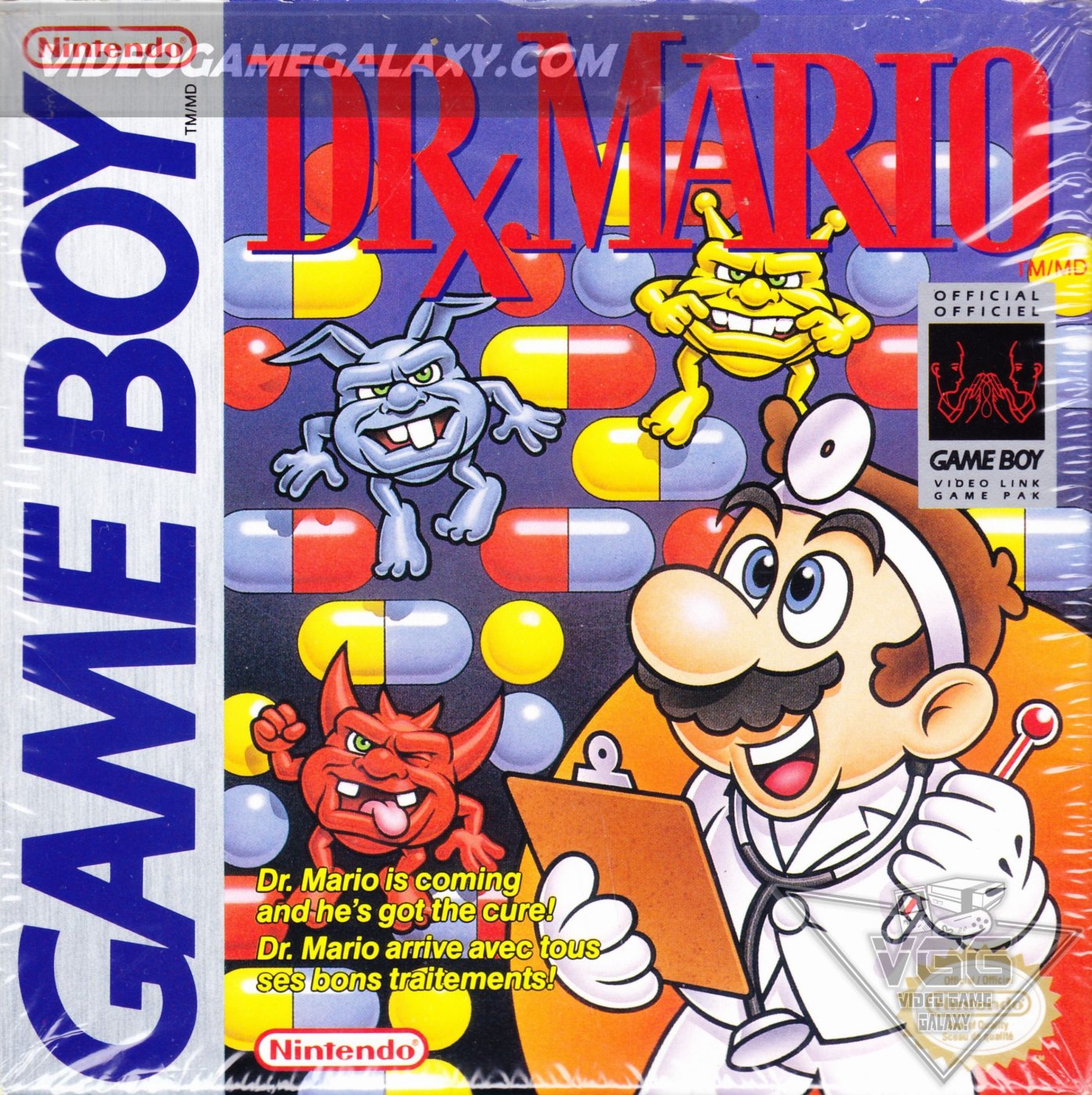
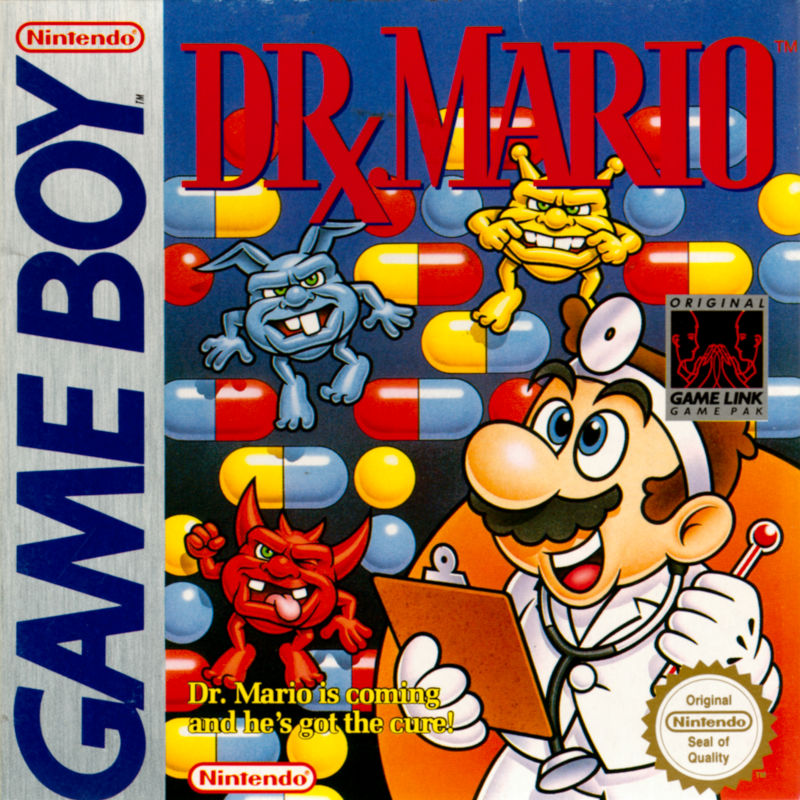
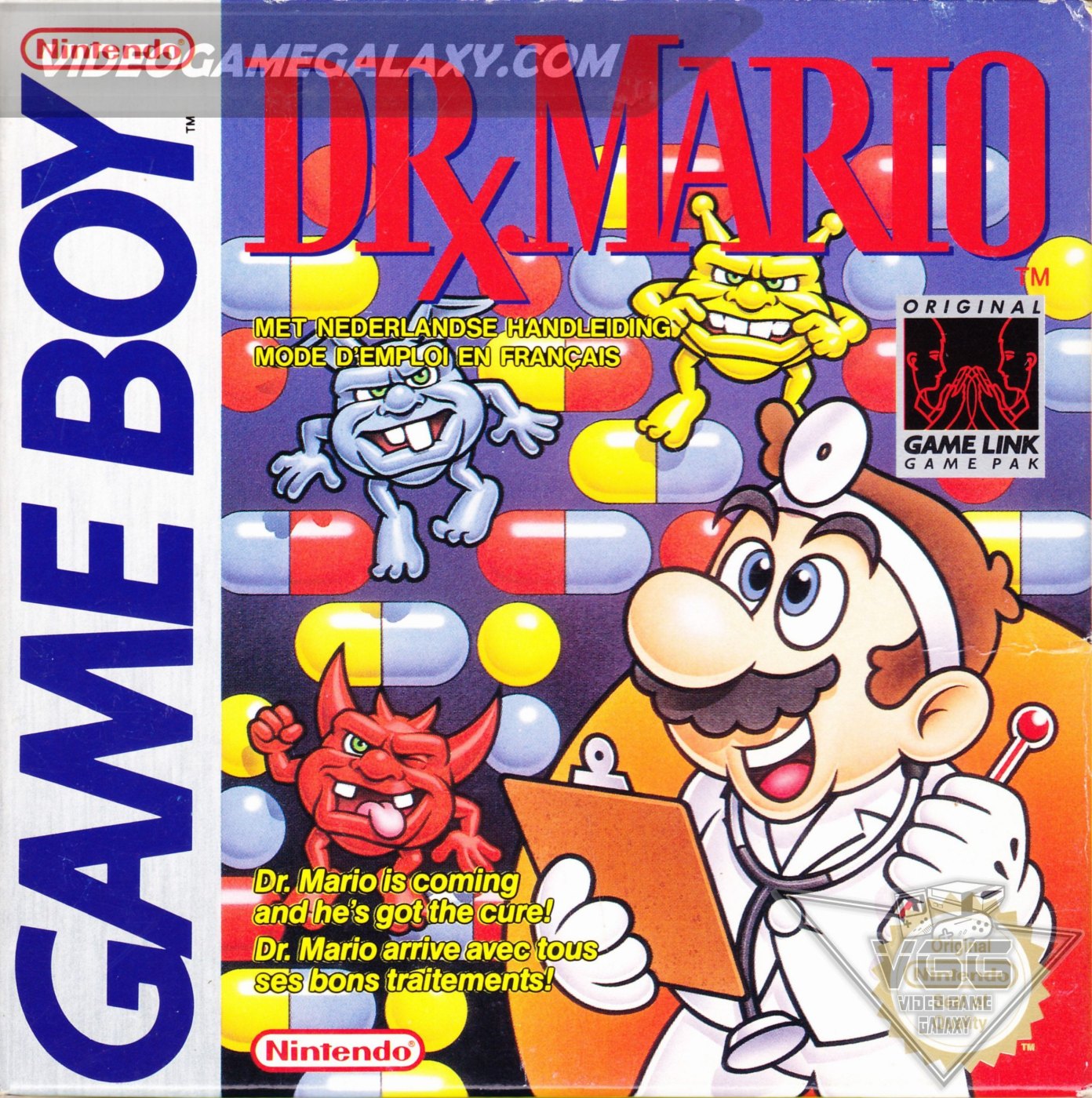
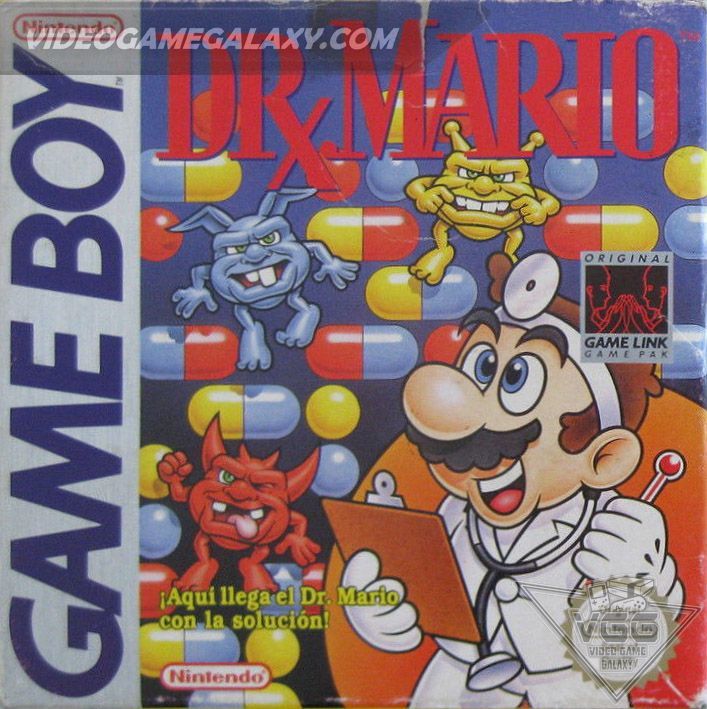
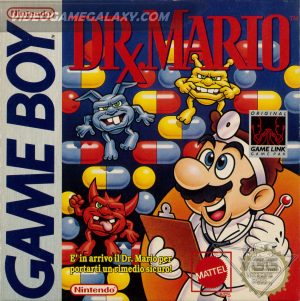
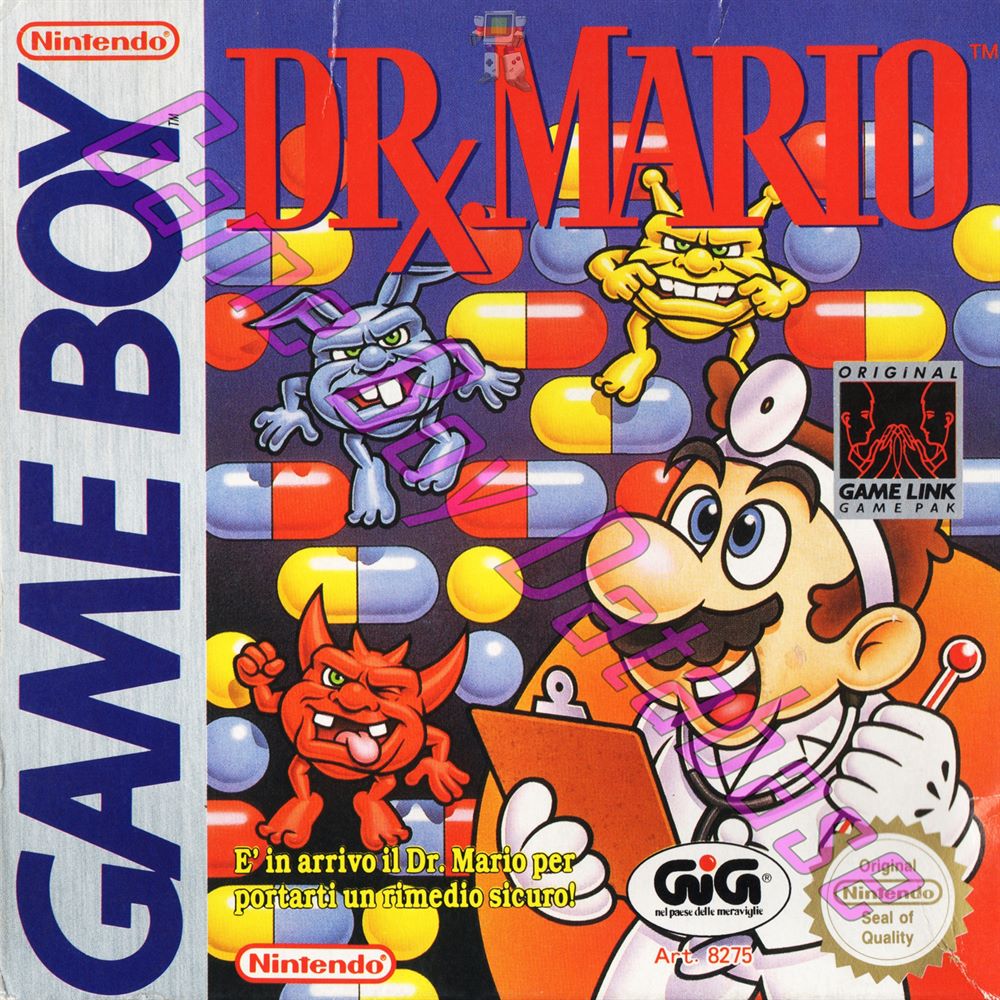
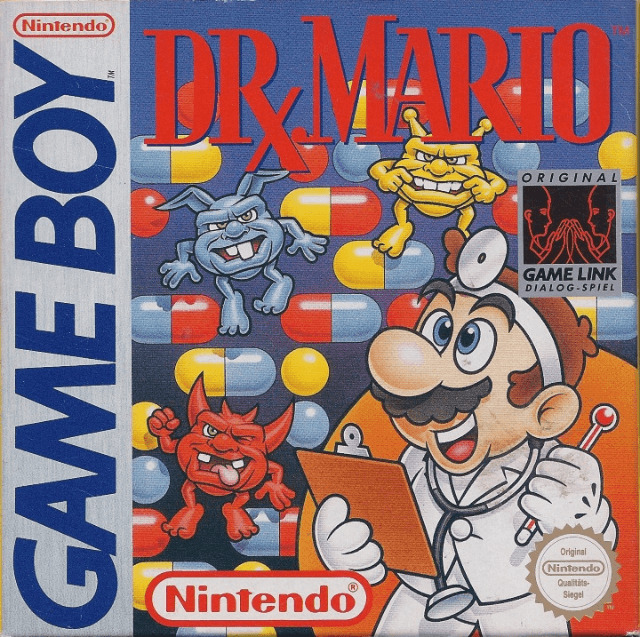
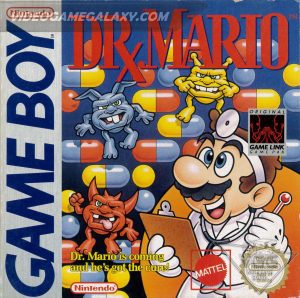
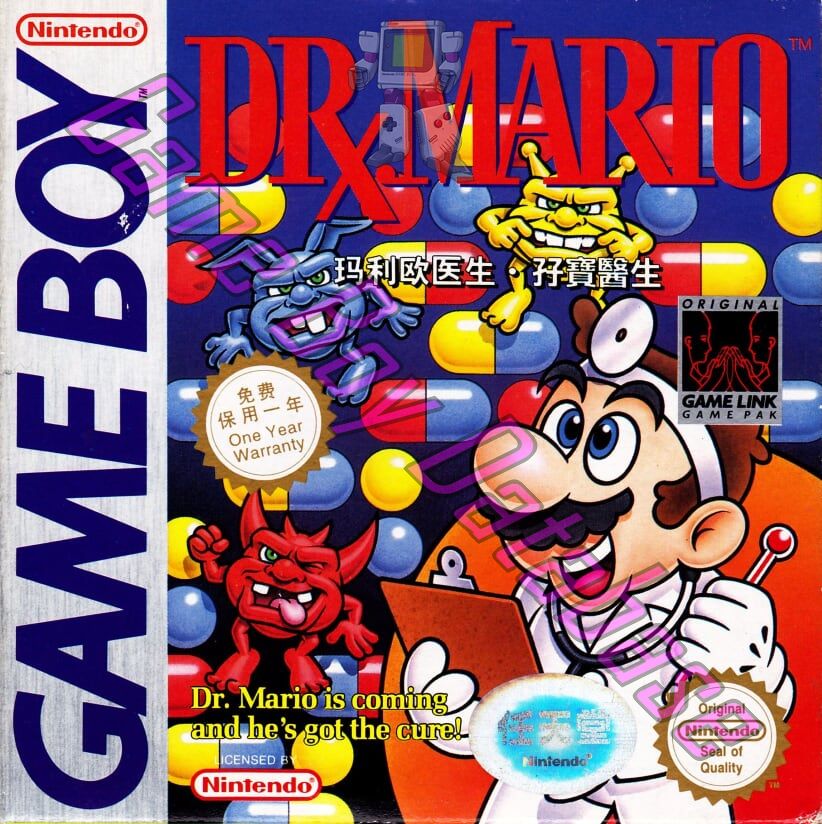
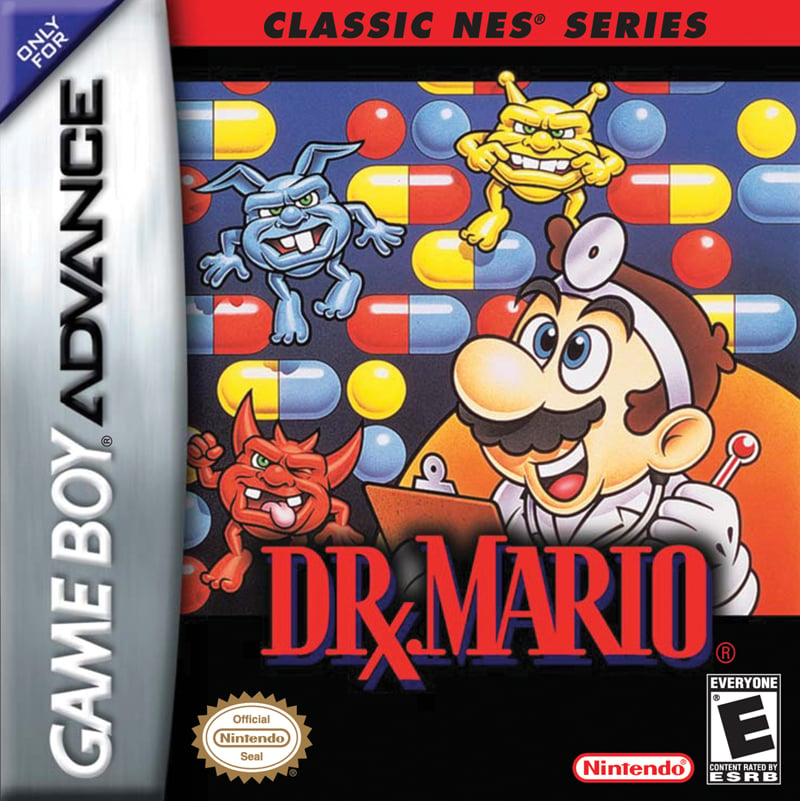
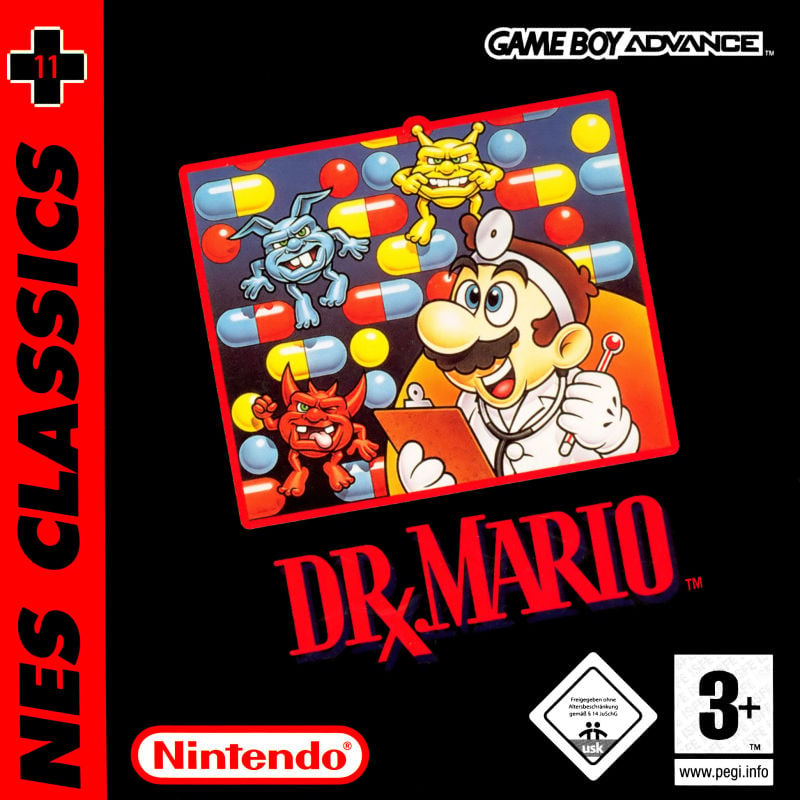
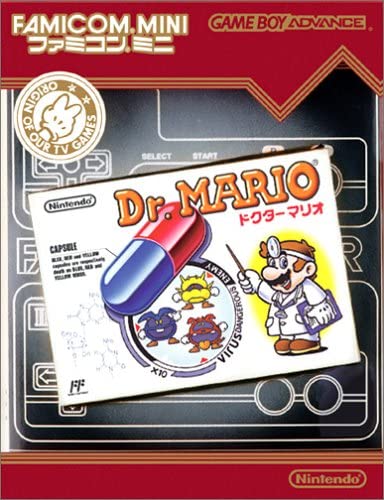
NES · North America (1990)NES · North America, backFamicom · Japan (1990)Famicom · Japan, backNES · CanadaNES · BrazilNES · Europe (1991)NES · ScandinaviaNES · France and the NetherlandsNES · SpainNES · ItalyNES · GermanyNES · AustraliaNES · South KoreaGame Boy · North America (1990)Game Boy · North America, backGame Boy · North America, Player’s Choice (1997)Game Boy · Japan (1990)Game Boy · CanadaGame Boy · Europe (1991)Game Boy · France and the NetherlandsGame Boy · SpainGame Boy · Italy (Mattel)Game Boy · Italy (GiG)Game Boy · GermanyGame Boy · Germany (alternate)Game Boy · AustraliaGame Boy · ChinaClassic NES Series · North America (2004)NES Classics · Europe (2005)Famicom Mini · Japan (2004)
Screenshots
More from both versions and the reissues.
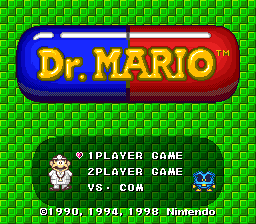
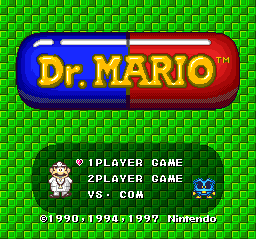
Game over on the Game Boy.The Game Boy version’s default palettes on Game Boy, Super Game Boy and Game Boy Color.The witch film on the NES.The flying fish on the Game Boy.The title screen of the 1998 Nintendo Power cartridge edition for Super Famicom.The Classic NES Series title screen on Game Boy Advance.A cleared bottle in the Classic NES Series edition.The Satellaview broadcast version, built on the Super NES remake.
Artwork & Media Gallery
Official artwork, logos, sprites and arcade material from the original Dr. Mario. Select any image to enlarge it.
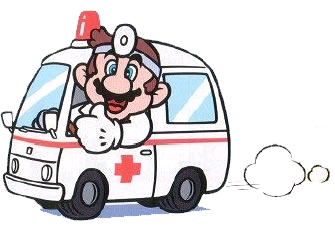
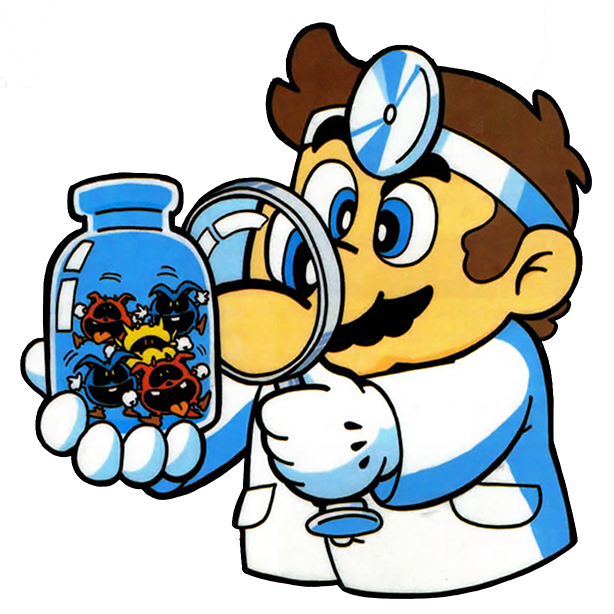
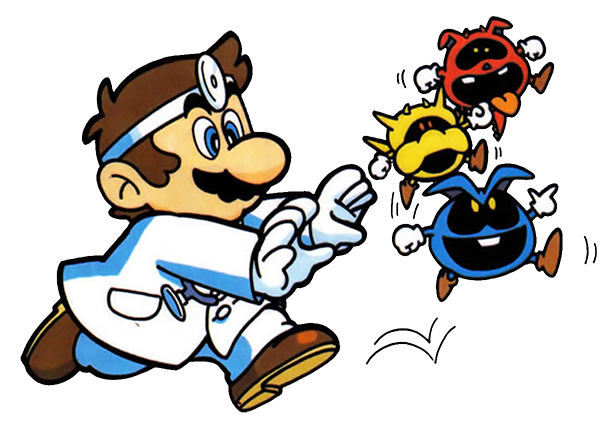
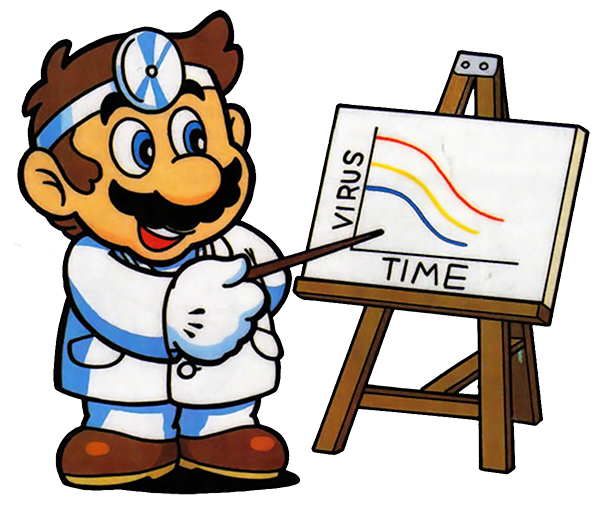
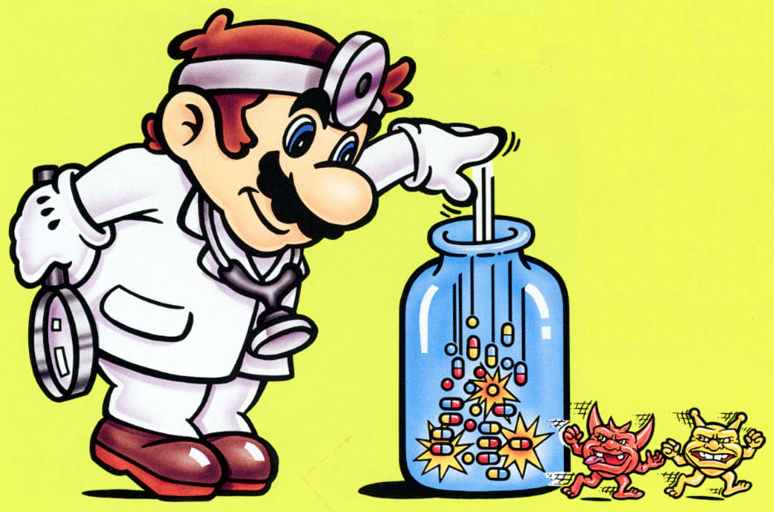
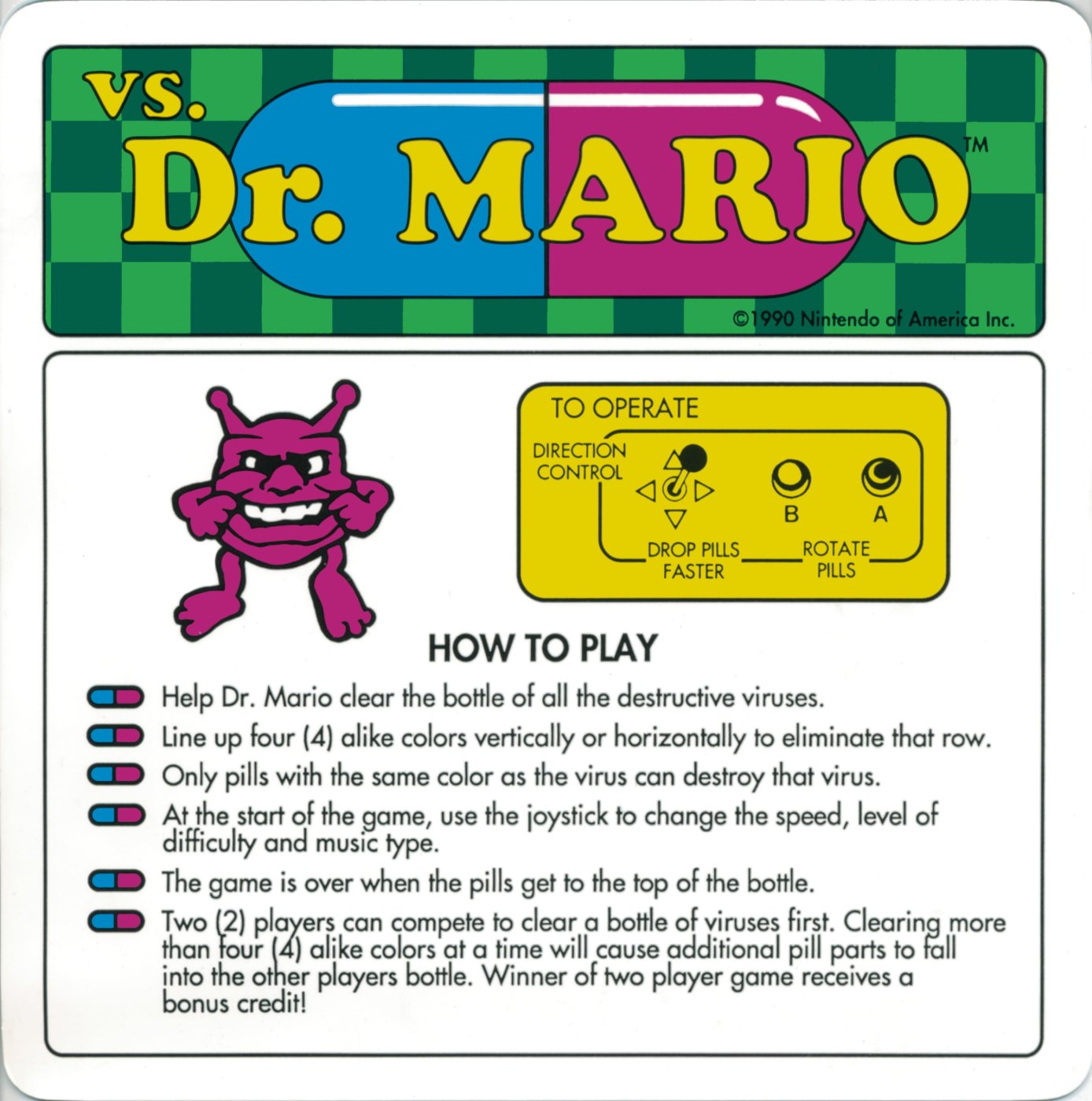
The international cover artwork.Dr. Mario giving a lesson.Dr. Mario in his ambulance.Dr. Mario throwing a capsule.Holding a bottle of viruses.Dr. Mario in a hurry.Studying the viruses (Nintendo Power).Chasing the viruses (Nintendo Power).A worried doctor (Nintendo Power).With a chart (Nintendo Power).The doctor’s tools (Nintendo Power).Filling a jar with capsules, from a 1991 PlayChoice-10 flyer.Artwork from VS. Dr. Mario.The three viruses.The red virus, alternative pose.The blue virus, alternative pose.The yellow virus, alternative pose.The 1990 international logo.The Japanese logo.The in-game logo on the NES.The in-game logo on the Game Boy.Dr. Mario’s NES sprite.Dr. Mario’s Game Boy sprite.The NES viruses dancing.The VS. Dr. Mario instruction card.A Kellogg’s Nintendo collector card.Dr. Mario in Super Smash Bros. for Nintendo 3DS and Wii U.The Dr. Mario logo in Tetris & Dr. Mario.The Dr. Mario logo in Dr. Mario & Puzzle League.
Legacy & Re-releases
The original has been reissued on nearly every Nintendo format since, and it started a series that is still going.
Ports and re-releases
Famicom and Game Boy27 July 1990Released in Japan on both systems the same day.
VS. System and PlayChoice-10August 1990Arcade versions in North America; also listed for Europe and Australia in 1990.
NESOctober 1990North America; Europe and Australia 27 June 1991.
Game Boy1990–1991North America late 1990; Europe 30 April 1991. A Player’s Choice edition followed in the US in 1997.
Tetris & Dr. MarioDecember 1994A 16-bit remake on Super NES, paired with Tetris; Europe 25 July 1995.
Satellaview1997–2000Dr. Mario BS Ban, a broadcast version based on the Super NES remake, sent out in Japan from March 1997 to June 2000.
LodgeNetLate 1990sHotel-room versions in the US, both alone and within Tetris & Dr. Mario. Neither has been preserved.
Nintendo Power cartridges1998 and 2000Download versions in Japan: Super Famicom from 1 June 1998, Game Boy from 1 March 2000.
Nintendo Puzzle Collection7 February 2003The Japanese GameCube collection could send the Famicom game to a Game Boy Advance over a link cable.
Classic NES Series / Famicom Mini2004–2005Game Boy Advance: Japan 21 May 2004, North America 25 October 2004, Europe 7 January 2005. See Classic NES Series: Dr. Mario.
Nintendo 3DS Virtual Console2011–2012Game Boy version: Japan 27 July 2011, Europe 2012, North America 4 October 2012. One player only.
Wii U Virtual Console2014NES version: Europe 13 February, Japan 26 February, North America 27 March.
NES Classic EditionNovember 2016One of the 30 built-in games, also on the Japanese Classic Mini Famicom.
Nintendo Switch OnlineSeptember 2018NES version at the service’s launch, with online two-player; the UFO cover-up edition followed on 12 December 2018.
Nintendo Switch OnlineMarch 2024Game Boy version, 11 March in the Americas and 12 March elsewhere.
The Dr. Mario family
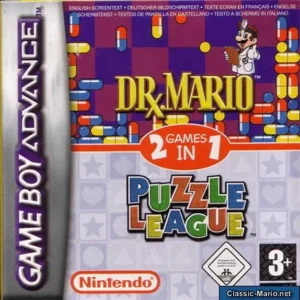
Nearly every sequel has kept the 1990 rules at its heart. Tetris & Dr. Mario (Super NES, 1994) remade the game in 16 bits alongside Tetris, with a Mixed Match mode that switches between the two. Dr. Mario 64 (Nintendo 64, 2001) added a story mode, Wario and battles for up to four. The Game Boy Advance had the straight NES port in the Classic NES Series (2004) and an enhanced version paired with Dr. Mario & Puzzle League (2005).
The download era began with Dr. Mario Online Rx (WiiWare, 2008), the first entry sold only as a download, with online play, Miis and a motion-control mode called Germ Buster, and Dr. Mario Express (DSiWare, from December 2008). Dr. Luigi (Wii U, 2013) handed the coat to Luigi and added L-shaped capsules, and Dr. Mario: Miracle Cure (3DS, 2015) brought random power-ups. The last so far, the free-to-play mobile game Dr. Mario World, launched on 9 July 2019 with capsules that float upwards and closed on 1 November 2021.
Reviews & Sales
Sales
Nintendo has never published a sales figure for the original game, so every number here comes from somewhere else. Famitsu’s figures, collected by the Game Data Library and quoted on Wikipedia, put Japanese sales at about 2.08 million on Game Boy and 1.53 million on Famicom, plus 248,045 for the 2004 Famicom Mini re-release on Game Boy Advance. The reference book Top 10 of Everything 2016 (Paul Terry, Hachette, 2015) gives worldwide sales of 5.34 million for the Game Boy version and 4.85 million for the NES version. Neither is an official Nintendo figure.
5.34mGame Boy, worldwide (Top 10 of Everything 2016)
4.85mNES, worldwide (same source)
2.08mGame Boy, Japan (Famitsu data)
1.53mFamicom, Japan (Famitsu data)
Reviews and scores
Most magazines liked it in 1990 and 1991, especially the two-player game; a few dismissed it as a Tetris copy. Later scores are for the Game Boy Advance and Wii U reissues.
FamitsuJapan · Game Boy · No. 106, 3 August 1990 (7, 8, 9, 7)
31/40
GameSpotGame Boy Advance reissue · Bob Colayco, 3 November 2004
7.4/10
Nintendo PowerGame Boy Advance reissue · No. 186, December 2004
7.2/10
IGNGame Boy Advance reissue · Craig Harris, 26 October 2004
7/10
MetacriticGame Boy Advance reissue · 10 reviews
66/100
Total!UK · Game Boy · January 1992
64%
Electronic Gaming MonthlyUS · Game Boy · No. 16, November 1990 (4, 6, 6, 7)
23/40
ACEUK · Game Boy · Tony Dillon, No. 38, November 1990
510/1000
Nintendo LifeWii U Virtual Console (NES) · Thomas Whitehead
5/10
GB ActionUK · Game Boy · No. 24, April 1994
42%
In America, Game Players found the NES game easy to pick up but hard to master, praised the two-player mode’s separate level and speed settings and called it 1990’s best NES puzzle game; in the same issue its Game Boy review judged the handheld version practically identical and well suited to the small screen. Britain was more divided. Mean Machines scored both versions in the high eighties, but ACE called the Game Boy version repetitive and plain and accused it of copying the games it imitated, and GB Action, reviewing it in 1994, told Tetris owners not to bother.
Some parents, according to Wikipedia and other references, were uneasy about a children’s game built around taking pills. Later verdicts were mixed: the Game Boy Advance reissue scored around seven out of ten, and Nintendo Life’s review of the Wii U Virtual Console release found it enjoyable but less compelling than Tetris.
Honours
Game Players · 1990Best NES puzzle gameThe magazine’s puzzle game of the year on the NES.
Nintendo Power · Vol. 100, September 1997No. 45The Game Boy version’s place in the 100 best Nintendo games of all time.
Game Informer · issue 200, December 2009No. 69The NES version in the magazine’s top 200 games of all time.
IGN · Top 100 NES GamesNo. 51The NES version’s placing.
Game Informer · June 2011No. 7Among the best Game Boy games.
SLB User Reviews
Dr. Mario has yet to receive a community review on Super Luigi Bros.
If you’ve played Dr. Mario and would like to submit a review, please get in touch.
More from the Super Luigi Bros Guide
These picture lists come from the earlier Super Luigi Bros guide to Dr. Mario and are kept here in full.
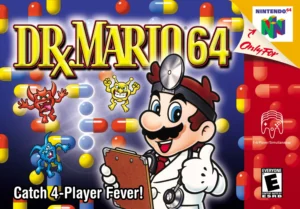
Dr. Mario 64 official artwork — the biggest and most ambitious entry in the series
Story mode: Dr. Mario faces Wario in Stage 1
The 13 default playable characters
Dr. Mario 64 is the most ambitious entry in the series — a full Nintendo 64 game wrapping the classic Megavitamin formula in a proper Story Mode, 15 characters, and 4-player simultaneous multiplayer. Released in North America in April 2001 (Japan two years later), it remains the most feature-rich Dr. Mario game ever made.
Story — Dr. Mario and the Cold Caper
Flu season has struck! Dr. Mario is busier than ever with his miraculous Megavitamins — but Wario and the sinister Mad Scienstein are plotting to steal the entire supply. Who is Mad Scienstein really working for? Dr. Mario must defeat every challenger to recover his medicine and unravel the conspiracy. Two full story paths available: play as Dr. Mario or Wario.
Game Modes
Mode
Description
Story Mode
Single-player narrative with cutscenes. Two story paths (Dr. Mario / Wario). Progress through increasingly tough virus battles against the full cast.
Classic 1-Player
Traditional Dr. Mario — choose level (0–20), speed, and clear all viruses.
Vs. Computer
Battle a CPU opponent — choose any character, set difficulty.
2-Player Battle
Head-to-head versus. Clear rows to dump garbage capsules on your opponent.
3 & 4-Player Battle
Series first! Three or four simultaneous players in free-for-all or Team Battle (2v2).
Team Battle (2v2)
Players 1 and 2 take on players 3 and 4, each player with their own bottle; garbage aimed at your partner is banked for your team instead. Tight co-ordination required.
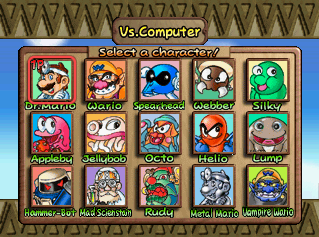
Playable Characters
15 characters — 13 from the start, 2 unlockable by completing Story Mode.
Dr. Mario
Wario
Spearhead
Webber
Silky
Appleby
🪼
Jellybob
🐙
Octo
🌞
Helio
🗿
Lump
🤖
Hammer-Bot
🧑🔬
Mad Scienstein
🤡
Rudy
🤖
Metal Mario 🔒
🧛
Vampire Wario 🔒
🔒 = Unlock by completing Story Mode
The complete 15-character lineup — including unlockable Metal Mario and Vampire Wario
Controls (N64)
Input
Action
+ Control Pad ←/→
Move capsule horizontally
+ Control Pad ↓
Drop capsule faster
A Button
Rotate clockwise
B Button
Rotate counter-clockwise
Start
Pause
Reception
Mixed to positive reviews. The four-player battle mode was universally praised as the standout feature. Story Mode was welcomed as a genuine addition to the puzzle game formula. The core gameplay — unchanged from 1990 — drew some criticism for lack of evolution but was appreciated by fans of the original.
Dr. Mario through the years
The Dr. Mario games with their own pages on Super Luigi Bros, with the year each first came out. The SNES remake in Tetris & Dr. Mario (1994) is covered above.
To provide the best experiences, we use technologies like cookies to store and/or access device information. Consenting to these technologies will allow us to process data such as browsing behavior or unique IDs on this site. Not consenting or withdrawing consent, may adversely affect certain features and functions.
Functional
Always active
The technical storage or access is strictly necessary for the legitimate purpose of enabling the use of a specific service explicitly requested by the subscriber or user, or for the sole purpose of carrying out the transmission of a communication over an electronic communications network.
Preferences
The technical storage or access is necessary for the legitimate purpose of storing preferences that are not requested by the subscriber or user.
Statistics
The technical storage or access that is used exclusively for statistical purposes.The technical storage or access that is used exclusively for anonymous statistical purposes. Without a subpoena, voluntary compliance on the part of your Internet Service Provider, or additional records from a third party, information stored or retrieved for this purpose alone cannot usually be used to identify you.
Marketing
The technical storage or access is required to create user profiles to send advertising, or to track the user on a website or across several websites for similar marketing purposes.


 CongratulationsNES · level 20, LowJust a message on a black screen and a slowed-down ending tune.
 The flying bookNES · level 5, MedA book flaps its covers across the sky from left to right.
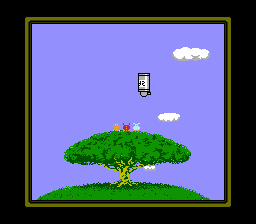 The spray canNES · level 15, MedAn upside-down aerosol rockets past on its own spray.
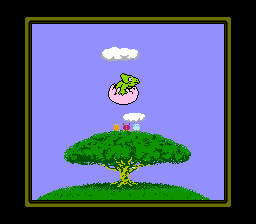 The dinosaur in an eggNES · level 20, MedA dinosaur sits in its egg and paddles slowly across.
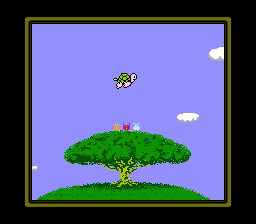 The tortoiseNES · level 5, HiA tortoise swims through thin air.
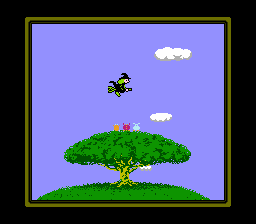 The witchNES · level 15, HiA witch crosses the sky on her broom.
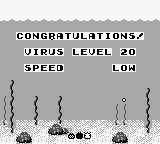 The sea floorGame Boy · level 20, LowThe viruses sit on the sea bed, and that is all.
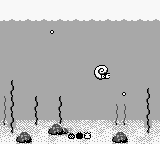 The nautilusGame Boy · level 20, MedA nautilus drifts slowly past.
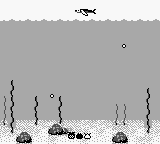 The flying fishGame Boy · level 15, HiA flying fish skims over the waves above.
 Vitamin capsuleTwo halves, each red, blue or yellow. Turn it with A and B and drop it with down on the pad.
 Red virusCleared by red segments. Present from level 0.
 Blue virusCleared by blue segments.
 Yellow virusCleared by yellow segments.

 Kellogg’s Nintendo collector cardsCereal promotionDr. Mario featured on cards and a sticker in Kellogg’s Nintendo series.
 Super Smash Bros. MeleeGameCube · 2001Dr. Mario became an unlockable fighter, throwing capsules, with Fever on the soundtrack. He returned in the 3DS and Wii U games and in Ultimate; in Brawl he was only a sticker, while Chill was arranged for the Flat Zone 2 stage.
 Dr. MarioThe doctor
 Nurse ToadstoolThe nurse
 Red virusVirus
 Blue virusVirus
 Yellow virusVirus
 The laughing trioNESThe three viruses in their laughing animation.
 Black virusGame BoyThe darkest of the three monochrome germs.
 Grey virusGame BoyThe middle shade.
 White virusGame BoyThe lightest, outlined in black.
 The Game Boy trioGame BoyAll three dancing in the status panel.



















 Dr. Mario 64 official artwork — the biggest and most ambitious entry in the series
 Story mode: Dr. Mario faces Wario in Stage 1
 The 13 default playable characters
 Dr. Mario
 Wario
 Spearhead
 Webber
 Silky
 Appleby
 The complete 15-character lineup — including unlockable Metal Mario and Vampire Wario